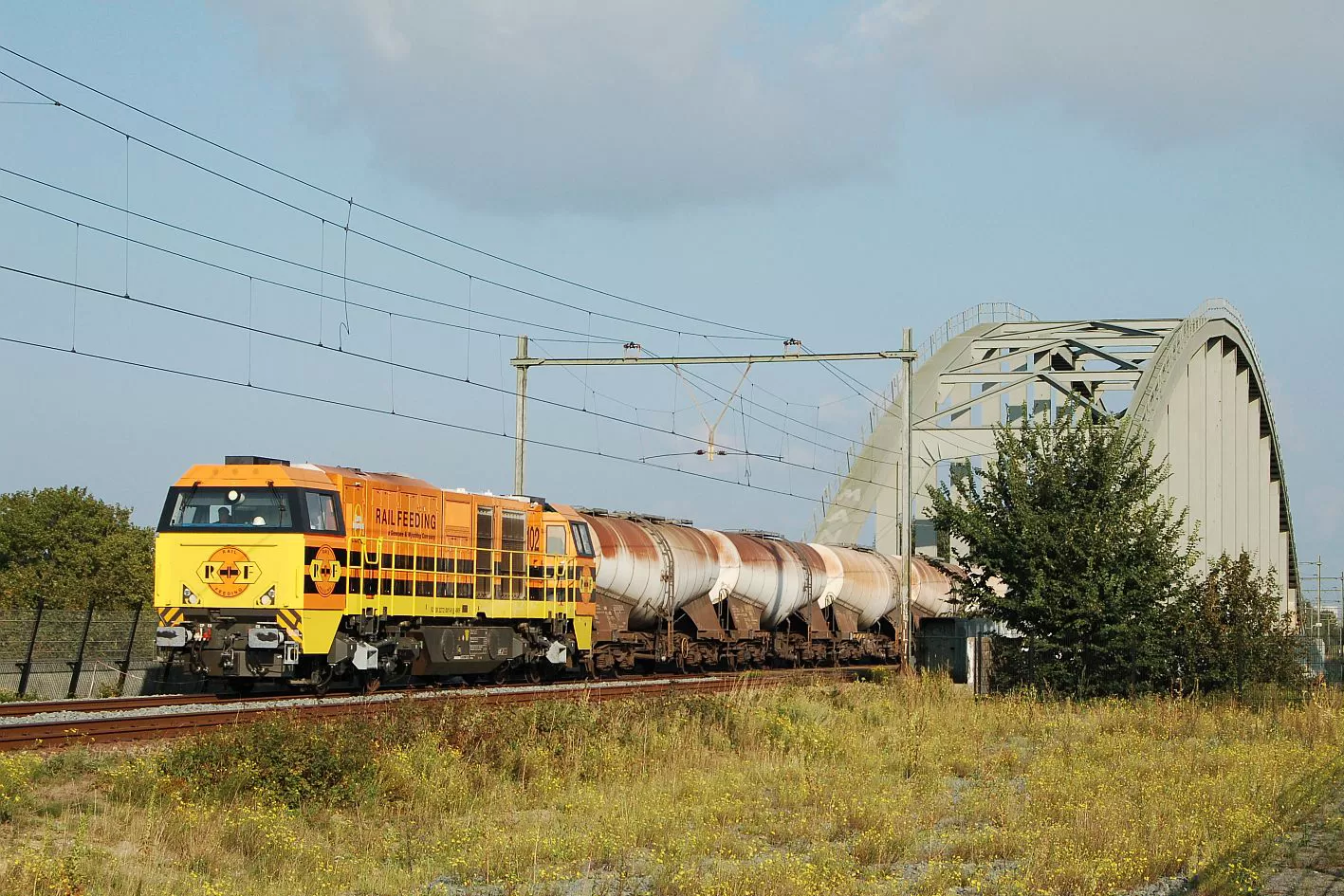
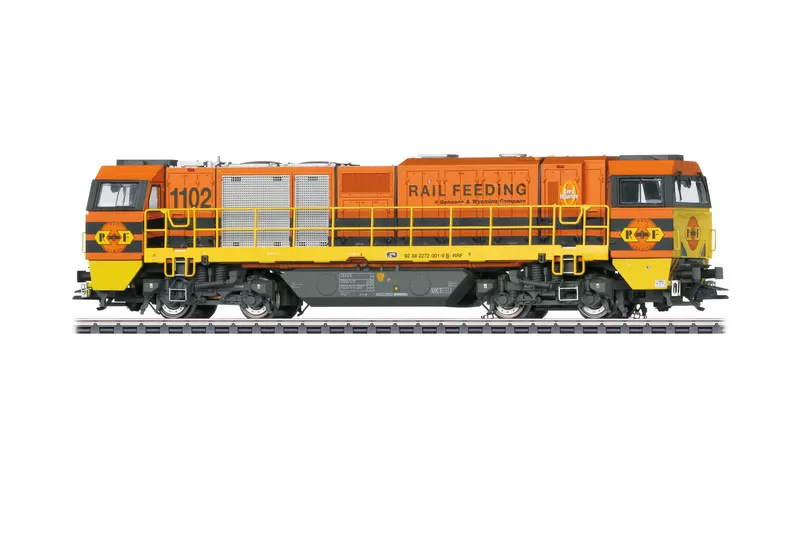
Rotterdam Rail Feeding (RRF) Vossloh G 2000-3 BB Die Baureihe G
2000 BB Diesellokomotive mit hydraulischem Antrieb gilt bei Vossloh
Locomotives GmbH (ehemals MaK) in Kiel als das leistungsstärkste
Modell seiner Art. Sie wurde erstmals in ihrer Originalversion im
September 2000 auf der Innotrans-Messe in Berlin, Deutschland,
präsentiert. Als erstes fiel dem Betrachter die schmale Aufbauten
mit seitlichen Gangways und die asymmetrischen Führerstände an den
Enden auf. Beide Enden in Fahrtrichtung zeigten den Führerstand an
der Vorderseite der Lokomotive, der sich links über die gesamte
Breite der Lokomotive erstreckte. Rechts endete der Führerstand auf
gleicher Höhe mit dem schmalen Aufbau. Daneben befand sich an
beiden Enden ein Wechselschritt, der hervorragend für den Betrieb
mit Funkfernsteuerung geeignet war. Damit konnten Rangierarbeiten
am Ende einer Fahrt problemlos und ohne eine zweite Lokomotive
durchgeführt werden. Besondere Merkmale der G 2000 BB sind ein voll
entwickeltes Baukastenprinzip, die Auswahl hochwertiger Komponenten
sowie ein hohes Maß an Zuverlässigkeit und Verfügbarkeit. Neben der
Originalversion, die nur aus 20 Einheiten bestand, wurde die G 2000
BB auch in zwei Variationen zwischen 2003 und 2010 mit einem
Führerstand über die gesamte Breite der Lokomotive gebaut. Dies
ermöglichte einen deutlich geräumigeren Führerstand mit zwei Sitzen
und ebenso guter Sicht auf die Strecke. Die ersten Einheiten als G
2000-2 BB (Führerpult auf der linken Seite) gingen an verschiedene
private Transportunternehmen in Italien, die G 2000-3 BB Variante
(46 Einheiten mit Führerpult auf der rechten Seite) nach
Frankreich, Belgien, die Niederlande und Deutschland. Die Varianten
G 2000-4 BB und G 2000-5 BB mit einem leistungsstärkeren MTU-Motor
umfassen jeweils nur eine Einheit. Mit ihrer Markteinführung setzte
die G 2000 neue Maßstäbe für Diesellokomotiven in Bezug auf Design,
Funktionalität und Lebenszykluskosten (LCC). Sie hat eine Leistung
von bis zu 2.700 Kilowatt / 3.621 PS, eine Höchstgeschwindigkeit
von 120 km/h / 75 mph, ein Tankvolumen von 5.000 Litern / 1.321
Gallonen und ein Dienstgewicht von 87 bis 90 metrischen Tonnen.
Diese Einheit kann nahezu überall eingesetzt werden. Die belgische
Leasingfirma Alpha Trains/Locomotives (bis Ende 2009: ACT – Angel
Trains Cargo, Antwerpen) erwarb eine ganze Reihe verschiedener
Varianten und stellte diese Einheiten allen Arten von Betreibern
zur Verfügung. Einer davon war Rotterdam Rail Feeding (RFF), das
2004 gegründet wurde und den Rangierdienst im und um den
Rotterdamer Hafen übernahm. Im April 2008 erwarb die amerikanische
Eisenbahngesellschaft Genesee & Wyoming die RFF. Ab 2011 betrieb
RFF sechs G 2000-3 BB Einheiten mit den Betriebsnummern 1101-1106
in seinem Bestand, jedoch nie gleichzeitig. Derzeit sind die
Betriebsnummern 1102-1104 noch im Bestand. Interessanterweise
hatten zumindest die Betriebsnummern 1101 und 1102 zeitweise das
typische orange-schwarze Farbschema von Genesee & Wyoming.
Automatische Übersetzung. Originaltext in: EN -
Original anzeigen
Rotterdam Rail Feeding (RRF) Vossloh G 2000-3 BB The class G 2000
BB diesel hydraulic locomotive is viewed at Vossloh Locomotives
GmbH (formerly MaK) in Kiel as the most powerful unit of its kind.
It was presented in its original version for the first time in
September of 2000 at the Innotrans Exhibition in Berlin, Germany.
The first thing to strike the observer was the narrow
superstructure with side catwalks and the asymmetrical cabs at the
ends. Both ends seen in the direction of travel showed the cab at
the front of the locomotive stretching to the left across the
complete width of the locomotive. To the right the cab ended even
with the narrow superstructure. Next to it, at both ends was a
switching step that was marvelously suited for operations with
radio remote control. With it, switching work occurring at the end
of a run could be done with no problem and without a second
locomotive. Special features of the G 2000 BB are a fully developed
building block design principle, the selection of high quality
components, as well as a high level of reliability and
availability. In addition to the original version comprising only
20 units, the G 2000 BB was also built in two variations between
2003 and 2010 with a cab across the entire width of the locomotive.
This enabled a considerably more spacious cab with two seats and
equally good sight down the track. The first units as the G 2000-2
BB (engineer's desk positioned on the left) went to different
private transportation firms in Italy, the G 2000-3 BB variant (46
units with engineer's desk positioned on the right) to France,
Belgium, the Netherlands, and Germany. The variants G 2000-4 BB and
G 2000-5 BB with a more powerful MTU motor comprise only one unit
each. At its introduction to the market, the G 2000 set new
standards for diesel road engines regarding design, functionality,
and life cycle costs (LCC). It has an output of up to 2,700
kilowatts / 3,621 horsepower, a maximum speed of 120 km/h / 75 mph,
5,000 liters / 1,321 gallons tank capacity, and a service weight of
87 to 90 metric tons. This unit can be used almost everywhere. The
Belgian leasing firm Alpha Trains/Locomotives (until the end of
2009: ACT – Angel Trains Cargo, Antwerp) acquired a whole series of
different variants and it made these units available to all kinds
of operators. One of these was Rotterdam Rail Feeding (RFF)
established in 2004, which took over switching service in and
around the Rotterdam Harbor. In April of 2008, the American
railroad firm Genesee & Wyoming acquired the RFF. Starting in 2011,
RFF was running six G 2000-3 BB units as road numbers 1101-1106 on
its roster, however never at the same time. Currently, road numbers
1102-1104 are still on the roster. Interestingly, at least road
numbers 1101 and 1102 had the typical orange/black paint scheme of
Genesee & Wyoming for a time.