
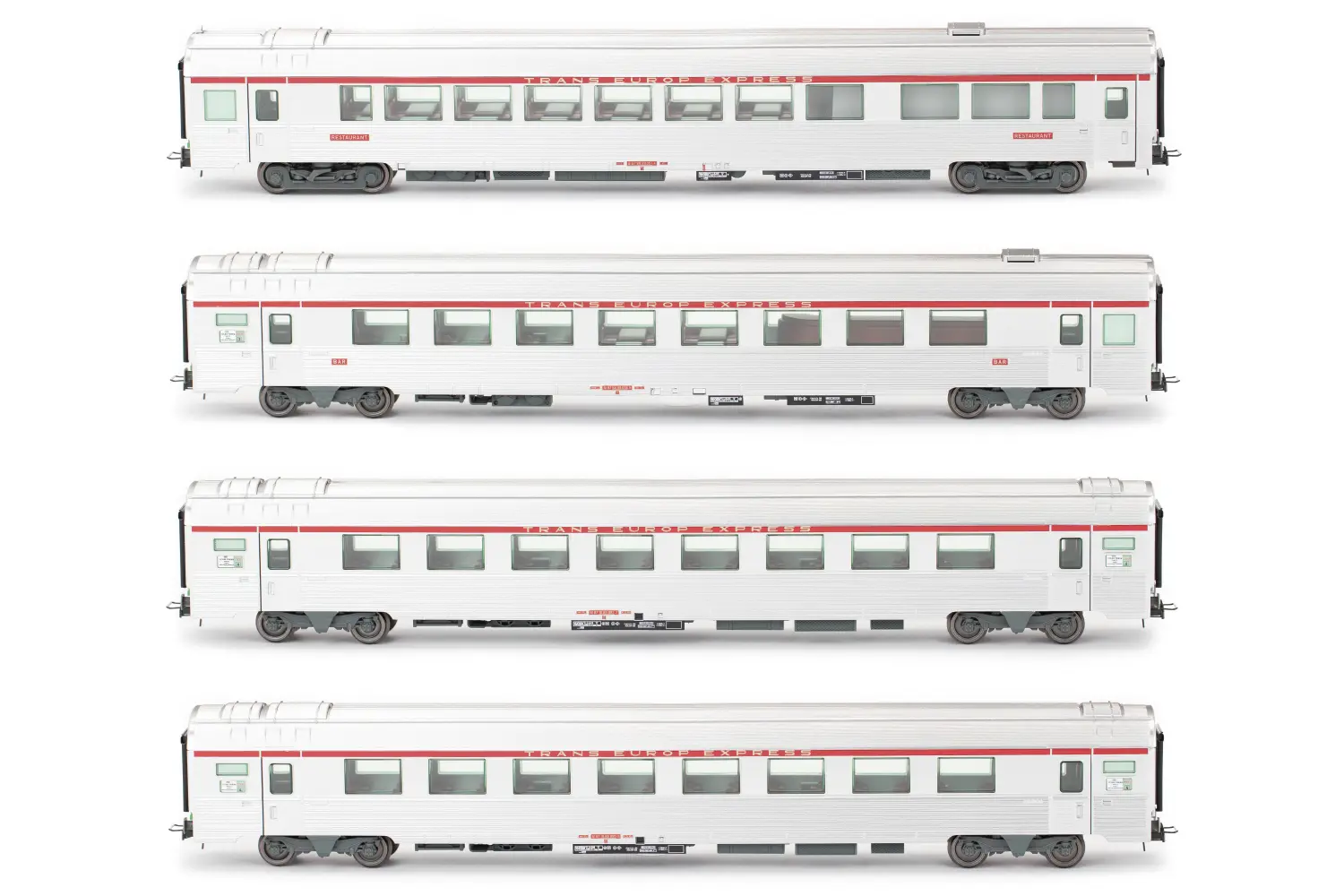
SNCF - "Mistral 69 / TEE Jules Verne" passenger coaches set

Scale:
Markings:
Add
About the model
The TEE "Jules Verne" operated in the morning from Nantes to Paris
under the number TEE 30 and in the late afternoon from Paris to
Nantes under the number TEE 31, with a single intermediate stop in
Angers. When it was launched on September 28, 1980, it was hauled
by a CC 72000, even on the electrified section between Le Mans and
Paris. Its operating hours were similar to those of the “Maine
Océan”, and the journey time was 3 hours and 17 minutes each way.
The carriages of the new Jouef HJ4205 and HJ4206HM models are
equipped with the innovative contact lighting system, which
operates in both analogue and digital modes. This system is
activated simply by touching a specific point on the upper roof of
each car with a fingertip. Additionally, the pack HJ4206HM comes
with a Hornby BLE sound decoder that reproduces the original diesel
engine sound of the generator car. This decoder can be controlled
via Bluetooth using your mobile phone or tablet, without the need
for an existing digital system, or via DCC, of course. History:
Almost 10 years ago, we developed a new set of CIWL coaches. These
models are very popular, but after many years on the market, we
were looking for something new to make them even more attractive.
That’s how we first equipped some items with interior lighting.
Inspired by the success of these models, we began looking for ways
to satisfy both DC and DCC customers—without installing expensive
decoders in the models. The solution we found was the CLS (Contact
Light System) with its memory function, an idea later adopted by
several competitors. At shows, many modellers asked us to extend
the use of CLS to all our Jouef items, including the Mistral ’69
coaches. Around the same time, one of our collaborators provided us
with a recording of the diesel generator inside the A4Dtux coaches.
Combined with the CLS concept and the new Hornby Bluetooth decoders
of the HM7000 system, the idea for the TEE “Jules Verne” (HJ4205
and HJ4206HM) was born. Both the interior lighting and the sound
decoder inside the generator van can be used on DC and DCC layouts.
Just as on the real train, the generator primarily serves as a
stable power supply when the train is not coupled to a locomotive
capable of providing electricity for the air conditioning and the
restaurant car. With that in mind—and considering that the sound
decoder can operate with any type of track power and connects
directly to the HM|DCC app on your mobile phone or tablet via
Bluetooth—the generator can also be started on a DC layout. Of
course, the DC supply must be stable for this. On a digitally
controlled layout, naturally, there are no such limitations, and
the generator sound can be activated at any time, either under DCC
control or via Bluetooth. The red taillights are also functional
under digital control.
...
Catalogs / brochures


Have photos of the real train?
Share your photos*
*and help us build Europe's largest digital hub for trains!
Available article numbers:
Jouef HJ4205
Technical specifications:

2-rail (direct current - DC)

Coupler standard pocket (NEM 362)

Coupler with close coupling cinematic

Interior LED lighting

With interior fittings

Length over buffers
1'168 mm

Minimum drivable radius
360 mm
Show more
SNCF - "Mistral 69 / TEE Jules Verne" passenger coaches set related products:
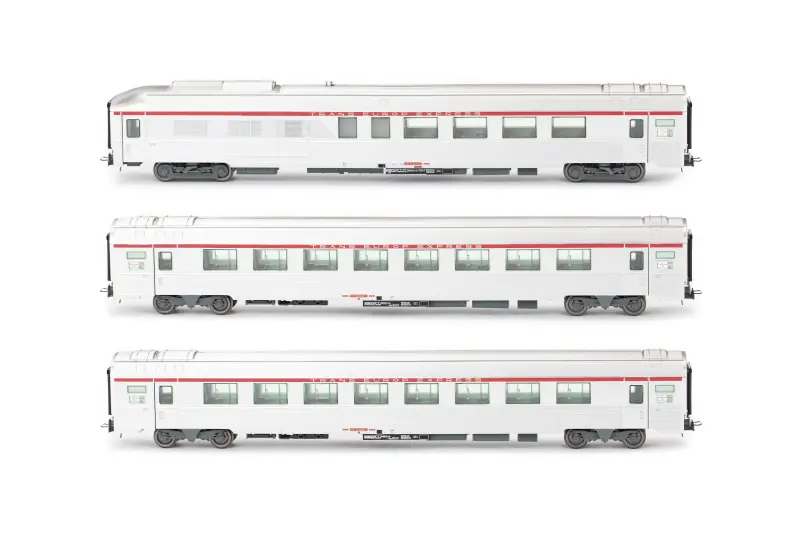
SNCF - "Mistral 69 / TEE Jules Verne" passenger coaches set
Recommended retail price: 309,90 €
Available since: 1st Quarter 2026
Advertising:

The identity card, photos and videos for thousands of railway vehicles all around Europe!
Copyright © 2026 T&H Services - All rights reserved
Powered by
