
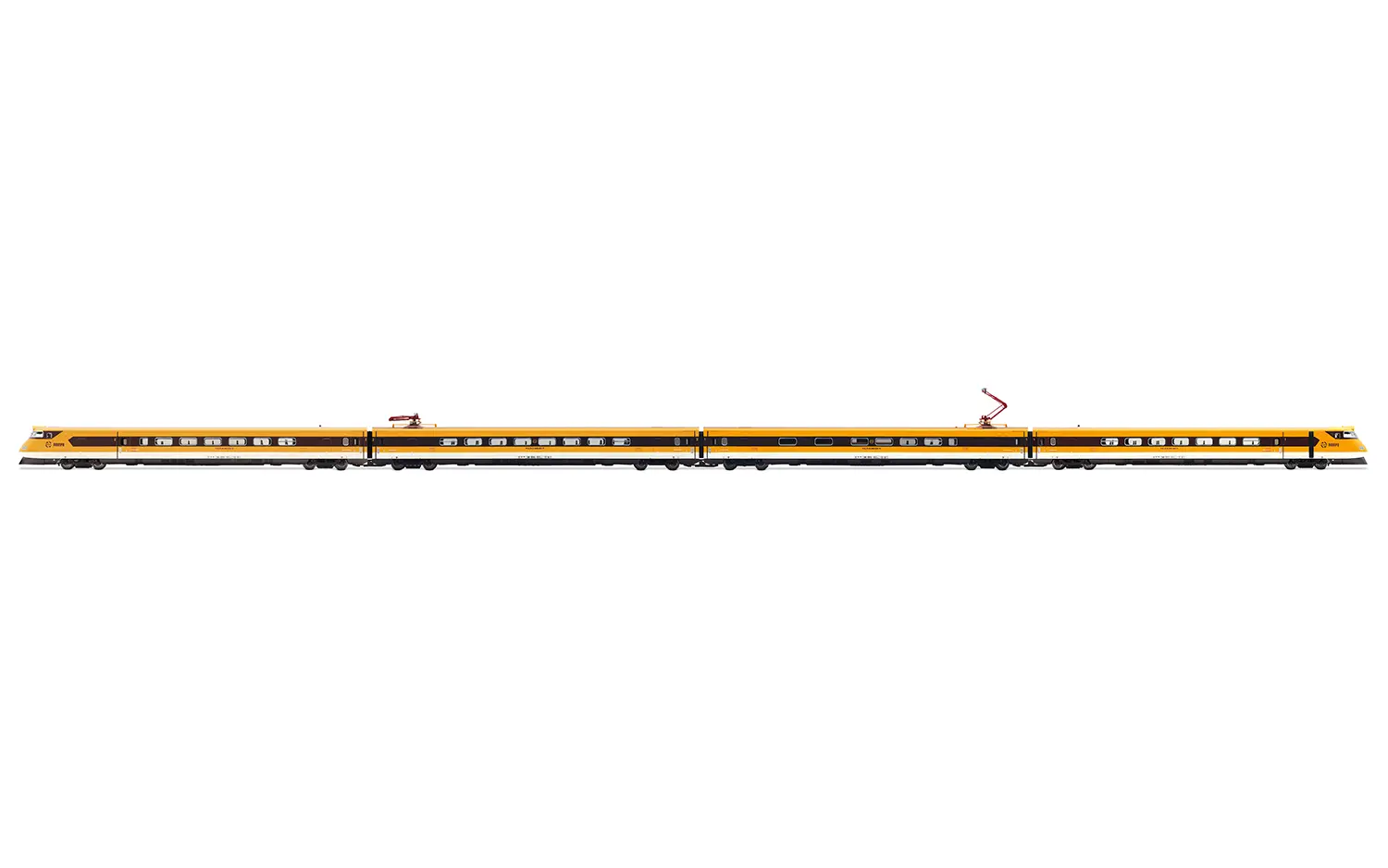
RENFE, tilting high-speed EMU class 443, with brown roof and modern logo, ep. IVb

Scale:
Markings:
Add
About the model
HistoryIn 1979, the first commercial service commenced between
Madrid and Albacete, soon expanding to the Madrid-Jaén route.
However, it was withdrawn again at the end of 1982 due to the
tilting system suffering from continuous breakdowns that limited
its speed. Two years later, it returned to CAF for refurbishment.
The converters were upgraded, and the exterior decoration was
updated. One of the outdated logos on the ends was replaced, and a
brown anti-corrosive paint strip was added along the entire roof.
This strip was applied differently on each of the end cars as an
experiment. Additionally, the pantographs were repainted
red.ModelThis latest livery is represented by Electrotren in the
new version with reference HE2015/HE2015S, incorporating all these
differences and peculiarities compared to previously manufactured
references. Throughout its history, the Electrotren Tilting Train
traveled extensively across the electrified Spanish railway
network, reaching diverse destinations such as Cádiz, Seville,
Valencia, Barcelona, Gijón, and Vigo, among others. It also
operated some tourist trains like the "Murallas de Ávila" and the
"Doncel de Sigüenza", before being retired from service in
September 1987. Additionally, it was used in numerous trials for
the initial high-speed studies, such as catenary interaction tests,
where it reached a speed of 206 km/h, setting a record for electric
traction at that time.
...
Catalogs / brochures
Available article numbers:
Electrotren HE2015
Technical specifications:

2-rail (direct current - DC)

DCC (Digital)

5-pole motor

Flywheel drive

21-pin interface (NEM 660)

Coupler standard pocket (NEM 362)

Coupler with close coupling cinematic

Triple headlights and two taillights alternating with the direction of travel
Two red taillights

Interior LED lighting

Can be switched over to overhead line operation

Locomotive - body chiefly made of metal

With interior fittings

Length over buffers
1220 mm

Minimum drivable radius
356.5 mm
Show more
Electrotren HE2015S
Technical specifications:
2-rail (direct current - DC)
DCC (Digital)
5-pole motor
Flywheel drive
21-pin interface (NEM 660)

Integrated sound
Coupler standard pocket (NEM 362)
Coupler with close coupling cinematic
Triple headlights and two taillights alternating with the direction of travel
Two red taillights
Interior LED lighting
Can be switched over to overhead line operation
Locomotive - body chiefly made of metal
With interior fittings
Length over buffers
1220 mm
Minimum drivable radius
356.5 mm
Show more
Advertising:

The identity card, photos and videos for thousands of railway vehicles all around Europe!
Copyright © 2026 T&H Services - All rights reserved
Powered by
