
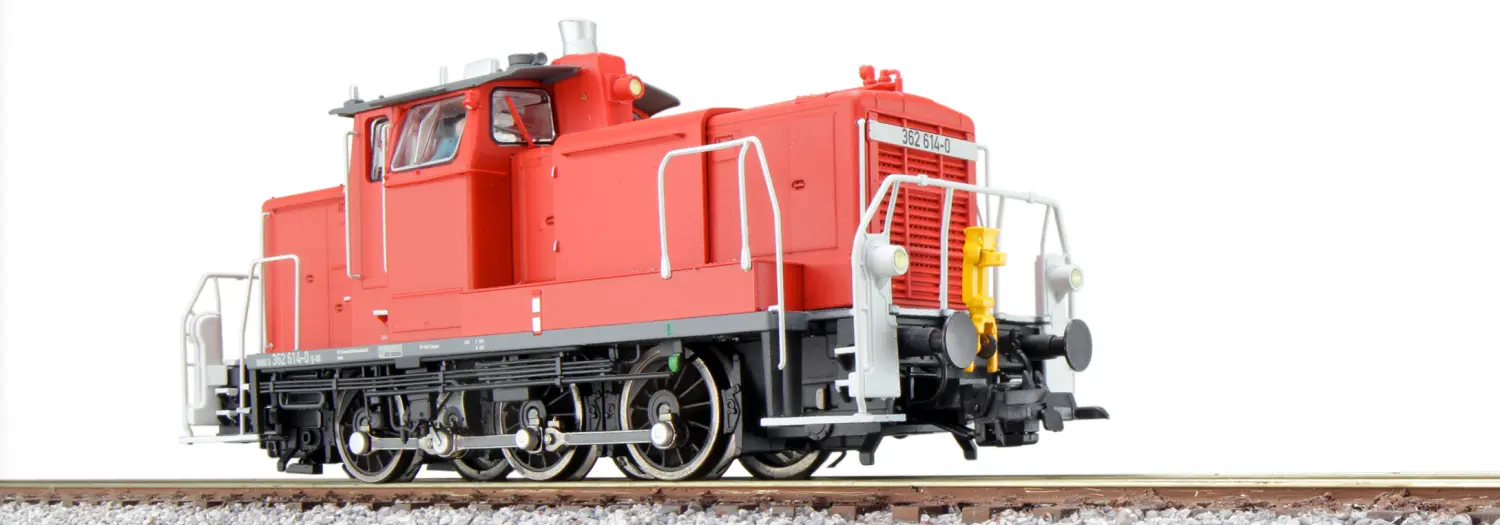
Diesellok V60

Scale:
Markings:
Add
About the model
Diesel locomotive 362 614 of DB AG, traffic red, Era VI
Prototype condition around 2014.
LokSound, smoke generator, shunting coupling, DC/AC, color variant
Model:
- LokSound decoder for DCC with RailComPlus®, Motorola®, M4, and Selectrix
- Independent registration at central units with RailComPlus® or mfx® functionality
- Universal electronics with plug-in slider
- Newly developed load-dependent smoke generator synchronized with LokSound
- Dual speaker with large sound capsule
- 31 special functions
- PowerPack storage capacitor for uninterrupted power supply
- Bell anchor motor with flywheel
- Digitally remote-controlled coupling in NEM pocket
- Prototype-compliant front lighting, cabin, and driver's desk lighting
- Chassis lighting
- Engraved light guides
- Body and frame made of metal
- Perforated fan grilles in the long front
- Robust yet delicate handrails made of metal and plastic
- Multicolored driver's cab with driver figure
- Minimum radius = 360 mm
- Length over buffers = 121 m
In the 1950s, the Deutsche Bundesbahn (DB) planned to procure a large number of three-axle shunting locomotives to modernize the shunting service. They opted for a drive with coupling rods and a blind axle. With a maximum speed of 60 km/h in service, the locomotive was as fast as the then-common through freight trains and utilized the permissible speed on branch lines. The coal-fired warming oven (Dofa oven) was only used to keep the parked V60 warm. From the 1990s, DB replaced the ovens with externally powered warming devices, eliminating the ovens at the front end below the right running board. Other external changes included the installation of induction magnets from the mid-1960s and, starting in 1985, the equipping of the majority of locomotives with automatic couplings. Internally, the series machines are divided into light and heavy locomotives. Externally, both types do not differ. The heavy version, weighing 54 tons, has a more robust frame than the light locomotives, which weigh only 48 tons. With the introduction of computer-compatible designations in 1968, the light locomotives received the series number 260, while the heavy ones were classified as 261. Until the early 1980s, both series of locomotives had to be staffed with personnel trained as locomotive drivers. Through a renumbering of the locomotives in 1987 into the series 360 and 361, DB assigned the machines to the small locomotives and created the job title of locomotive shunting driver for the shunters trained as locomotive personnel. The machines equipped with automatic coupling (AK) and radio remote control were designated 364 (light type) and 365 (heavy type). The BR 362 and 363 were only developed from 1992 and refer to locomotives equipped with the Caterpillar engine 3412 DI-TA instead of the original Maybach GTO 6 / GTO 6A.
...
Prototype condition around 2014.
LokSound, smoke generator, shunting coupling, DC/AC, color variant
Model:
- LokSound decoder for DCC with RailComPlus®, Motorola®, M4, and Selectrix
- Independent registration at central units with RailComPlus® or mfx® functionality
- Universal electronics with plug-in slider
- Newly developed load-dependent smoke generator synchronized with LokSound
- Dual speaker with large sound capsule
- 31 special functions
- PowerPack storage capacitor for uninterrupted power supply
- Bell anchor motor with flywheel
- Digitally remote-controlled coupling in NEM pocket
- Prototype-compliant front lighting, cabin, and driver's desk lighting
- Chassis lighting
- Engraved light guides
- Body and frame made of metal
- Perforated fan grilles in the long front
- Robust yet delicate handrails made of metal and plastic
- Multicolored driver's cab with driver figure
- Minimum radius = 360 mm
- Length over buffers = 121 m
In the 1950s, the Deutsche Bundesbahn (DB) planned to procure a large number of three-axle shunting locomotives to modernize the shunting service. They opted for a drive with coupling rods and a blind axle. With a maximum speed of 60 km/h in service, the locomotive was as fast as the then-common through freight trains and utilized the permissible speed on branch lines. The coal-fired warming oven (Dofa oven) was only used to keep the parked V60 warm. From the 1990s, DB replaced the ovens with externally powered warming devices, eliminating the ovens at the front end below the right running board. Other external changes included the installation of induction magnets from the mid-1960s and, starting in 1985, the equipping of the majority of locomotives with automatic couplings. Internally, the series machines are divided into light and heavy locomotives. Externally, both types do not differ. The heavy version, weighing 54 tons, has a more robust frame than the light locomotives, which weigh only 48 tons. With the introduction of computer-compatible designations in 1968, the light locomotives received the series number 260, while the heavy ones were classified as 261. Until the early 1980s, both series of locomotives had to be staffed with personnel trained as locomotive drivers. Through a renumbering of the locomotives in 1987 into the series 360 and 361, DB assigned the machines to the small locomotives and created the job title of locomotive shunting driver for the shunters trained as locomotive personnel. The machines equipped with automatic coupling (AK) and radio remote control were designated 364 (light type) and 365 (heavy type). The BR 362 and 363 were only developed from 1992 and refer to locomotives equipped with the Caterpillar engine 3412 DI-TA instead of the original Maybach GTO 6 / GTO 6A.
Catalogs / brochures
Available article numbers:
ESU 31742
Technical specifications:

2-rail (direct current - DC)

3-rail (alternating current - AC)

DCC (Digital)

Flywheel drive

Integrated sound

Smoke generator

With interior fittings

Length over buffers
121 mm

Minimum drivable radius
360 mm
Show more
Advertising:

The identity card, photos and videos for thousands of railway vehicles all around Europe!
Copyright © 2026 T&H Services - All rights reserved
Powered by
