
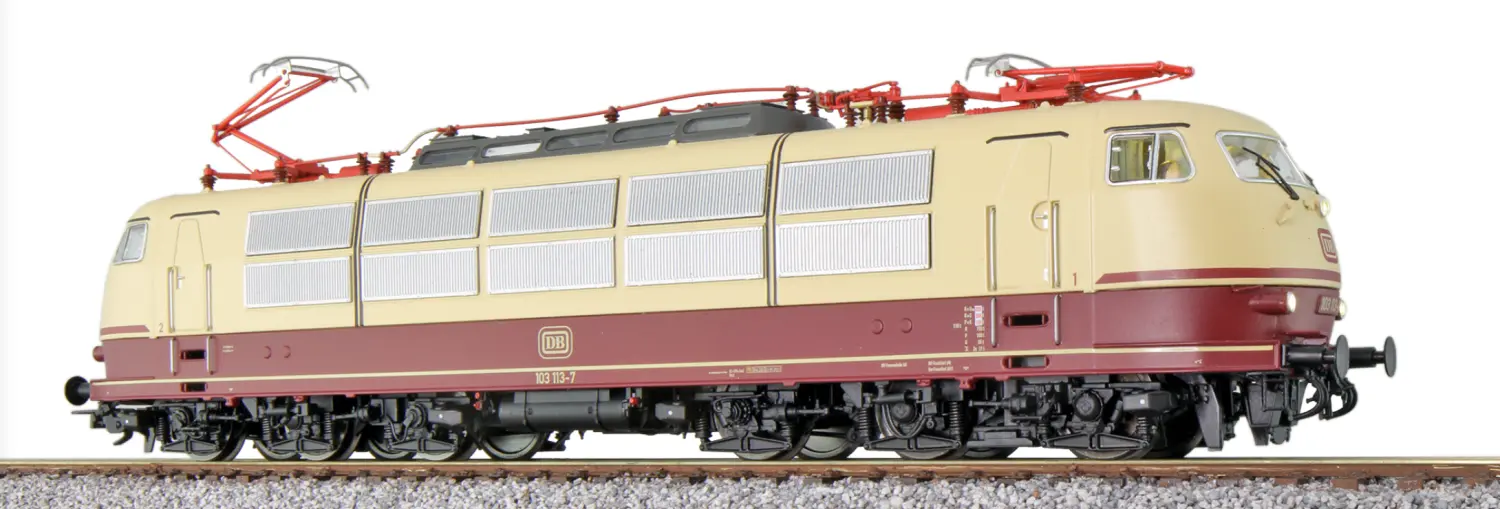
DB - E-Lok E03 / 103.1

Scale:
Markings:
Add
About the model
Electric locomotive, 103 113 of DB AG in TEE livery, Era VI
Prototype condition around 2020
LokSound, Pantograph, DC/AC
FORM VARIANT
- Body and chassis made of metal
- Multi-part bogie covers with real springs and numerous attached details
- Separately installed braking system with brake shoes at wheel level
- Separately attached handrails
- Coupling in a guide-controlled standard socket
- Powerful five-pole ESU motor with two balanced flywheels
- Drive via cardan/screw drive on three axles, four traction tires
- LokSound 5 decoder for DCC, Motorola®, M4, and Selectrix operation
- Independent registration at central units with RailComPlus® or mfx® functionality
- PowerPack storage capacitor for uninterrupted power supply
- Two high-quality speakers for the best sound enjoyment
- Universal electronics with plug slider for switching between two-rail and middle-rail operation
- Two digitally individually liftable and lowerable roof pantographs
- Digitized original sounds of a 103.1
- Sensor-controlled sounds during curve travel and when braking just before stopping
- Direction-dependent light change white/red, train-side front signal can be switched off, shunting, driver's cab, driver's desk, and machine room lighting
- Brake sparks during sharp braking
- Minimum radius = 360 mm
- Length over buffers = 224.1 mm
The E03, presented in 1965 in four pre-series examples, and its 145 series-built sister locomotives from 1970 were already legends in their lifetime. The Deutsche Bundesbahn developed the E03 primarily with Henschel and Krauss-Maffei to transport light TEE trains at high speeds in flat terrain. With E03 001, high-speed trials for the scheduled transport of passenger trains at 200 km/h began in 1965. The spherical front ends developed in wind tunnel tests and the elegant TEE livery shaped the image of high-speed transport in Germany for more than 30 years. In 1969, DB changed the requirements for the E03 and raised the train weight for the series locomotives to 480 t at 200 km/h and 800 t at 160 km/h. Therefore, the power of the engines was increased to 7780 kW. Externally, the series locomotives designated as BR 103.1 differed significantly from the pre-series by the second fan band in the side walls and the simplified livery without a silver decorative strip between the purple and beige areas. Since trains with maximum speeds over 140 km/h had to be staffed with two drivers, the personnel of the last series of locomotives were given a bit more space with extended driver's cabs. The pre-series locomotive 103 004 received single-arm pantographs and an umbra gray instead of silver roof in the 1970s. Initially working in regular train service, it soon primarily served in measurement and testing service, for example, in preliminary operations for the introduction of the ICE. The opening of the IC train system for second-class passengers in 1979 made the 103 heavy workers. Although the high-speed locomotives were now permanently loaded to the limits of their performance, they still impressed with great reliability and remained indispensable for DB AG well into the new millennium. The DB Museum keeps several 103 locomotives operational for special assignments, including 103 113.
...
Prototype condition around 2020
LokSound, Pantograph, DC/AC
FORM VARIANT
- Body and chassis made of metal
- Multi-part bogie covers with real springs and numerous attached details
- Separately installed braking system with brake shoes at wheel level
- Separately attached handrails
- Coupling in a guide-controlled standard socket
- Powerful five-pole ESU motor with two balanced flywheels
- Drive via cardan/screw drive on three axles, four traction tires
- LokSound 5 decoder for DCC, Motorola®, M4, and Selectrix operation
- Independent registration at central units with RailComPlus® or mfx® functionality
- PowerPack storage capacitor for uninterrupted power supply
- Two high-quality speakers for the best sound enjoyment
- Universal electronics with plug slider for switching between two-rail and middle-rail operation
- Two digitally individually liftable and lowerable roof pantographs
- Digitized original sounds of a 103.1
- Sensor-controlled sounds during curve travel and when braking just before stopping
- Direction-dependent light change white/red, train-side front signal can be switched off, shunting, driver's cab, driver's desk, and machine room lighting
- Brake sparks during sharp braking
- Minimum radius = 360 mm
- Length over buffers = 224.1 mm
The E03, presented in 1965 in four pre-series examples, and its 145 series-built sister locomotives from 1970 were already legends in their lifetime. The Deutsche Bundesbahn developed the E03 primarily with Henschel and Krauss-Maffei to transport light TEE trains at high speeds in flat terrain. With E03 001, high-speed trials for the scheduled transport of passenger trains at 200 km/h began in 1965. The spherical front ends developed in wind tunnel tests and the elegant TEE livery shaped the image of high-speed transport in Germany for more than 30 years. In 1969, DB changed the requirements for the E03 and raised the train weight for the series locomotives to 480 t at 200 km/h and 800 t at 160 km/h. Therefore, the power of the engines was increased to 7780 kW. Externally, the series locomotives designated as BR 103.1 differed significantly from the pre-series by the second fan band in the side walls and the simplified livery without a silver decorative strip between the purple and beige areas. Since trains with maximum speeds over 140 km/h had to be staffed with two drivers, the personnel of the last series of locomotives were given a bit more space with extended driver's cabs. The pre-series locomotive 103 004 received single-arm pantographs and an umbra gray instead of silver roof in the 1970s. Initially working in regular train service, it soon primarily served in measurement and testing service, for example, in preliminary operations for the introduction of the ICE. The opening of the IC train system for second-class passengers in 1979 made the 103 heavy workers. Although the high-speed locomotives were now permanently loaded to the limits of their performance, they still impressed with great reliability and remained indispensable for DB AG well into the new millennium. The DB Museum keeps several 103 locomotives operational for special assignments, including 103 113.
Catalogs / brochures
Available article numbers:
ESU 31176
Technical specifications:

2-rail (direct current - DC)

3-rail (alternating current - AC)

DCC (Digital)

Flywheel drive

5-pole motor

Integrated sound

Number of axles with traction tyres
4

Number of driven axles
3

Coupler standard pocket (NEM 362)

Coupler with close coupling cinematic

Triple headlights and two taillights alternating with the direction of travel

Two red taillights

With interior fittings

Length over buffers
224.1 mm

Minimum drivable radius
360 mm
Show more
Advertising:

The identity card, photos and videos for thousands of railway vehicles all around Europe!
Copyright © 2026 T&H Services - All rights reserved
Powered by
