
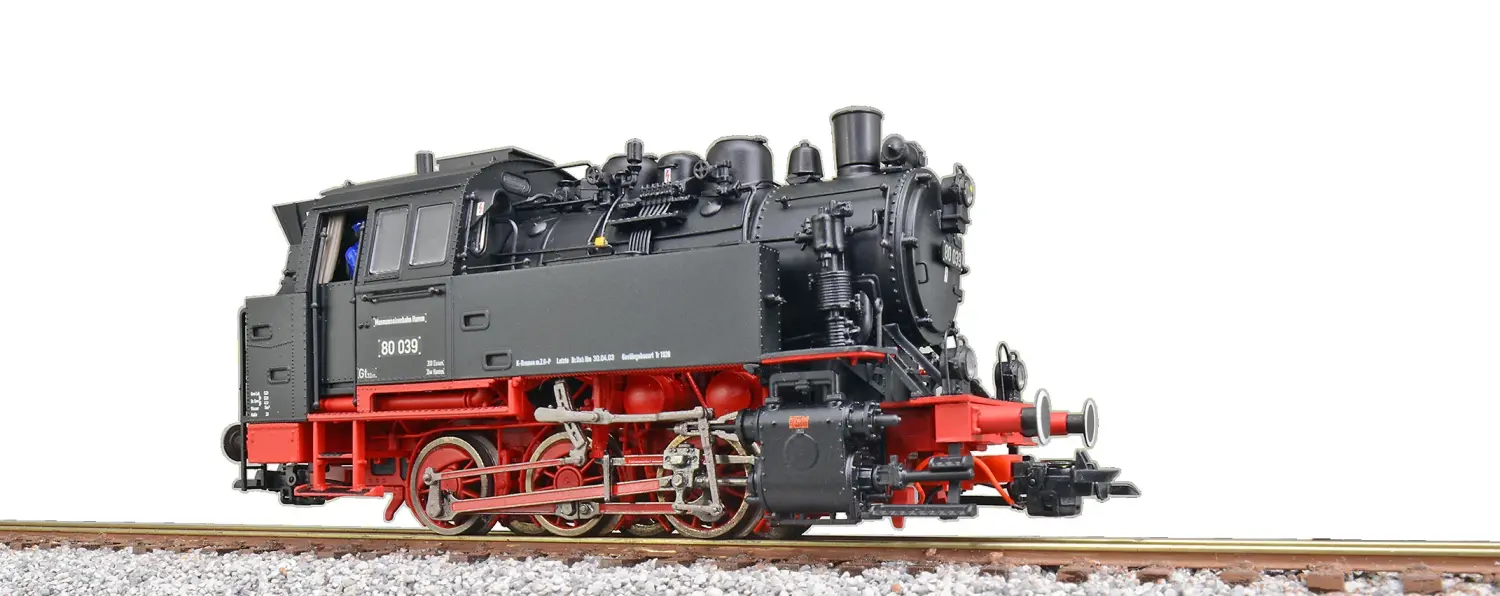
Dampflok BR 80

Scale:
Markings:
Add
About the model
Steam locomotive Class 80 (80 039) Museum, black, Era VI
Original condition around 2010
LokSound, double smoke generator, shunting coupling, DC/AC
NEW FORM
Model:
- Chassis, frame, water boxes, and smoke chamber made of metal
- DC/AC universal electronics
- Bell armature motor with flywheel
- LokSound 5 decoder for DCC, Motorola®, M4, and Selectrix® operation
- Independent registration via RailComPlus® at appropriately equipped DCC central units
- Independent registration at Märklin® mfx central units
- PowerPack storage capacitor for interruption-free power supply
- Pulsed double smoke generator for sensor-controlled smoke emission and cylinder steam synchronized with LokSound
- Double speaker with large sound capsule for maximum sound enjoyment
- Universal electronics with plug slider and switch for switching between two-rail and center-rail operation
- Digitally remote-controlled couplings
- Chassis lighting
- Metal wheels
- Locomotive crew in the cab
- Etched plates for self-assembly included
- Pipette for filling the smoke generator included
- Minimum radius 360 mm
- Length over buffers = 114 mm
Prototype:
In the standard locomotive program for steam locomotives of the German Reichsbahn-Gesellschaft DRG, there was also a three-axle class for heavy shunting service. For this class, the DRG specified a maximum axle load of 17.5 t, which was only moderately exceeded to 18.1 t at acceptance thanks to several tricks. This class made optimal use of the possibilities of track facilities in shunting yards and industrial areas near cities. Unlike the numerous larger locomotives that originated from the state railway era, the 80 was more powerful and at the same time more economical. Due to the powerful boiler, the three-coupled locomotives earned the nickname "Bulli." Despite the undeniable advantages of the modern design, the DRG limited itself to the 39 units procured in 1928 and 1929 due to the economically difficult situation. Mostly at passenger stations, the locomotives scurried over the tracks at a maximum permissible speed of 45 km/h. By 1966, the reliable locomotives had disappeared from the shunting yards of the two German state railways. The V60 of both designs provided similar pulling power but were even more versatile due to their higher top speed. At not even 40 years old, the 80s were not yet considered old iron. Both state railways used Bullis in repair shops or sold them to industrial companies or coal mines, which gratefully relied on the proven locomotives. For example, a handful of 80s worked in coal mines in the Ruhr area. There, they were even used for internal passenger trains. The last operational Bullis were the 80 036 and 80 039, which were delivered to the Veluwsche Stoomtrein Maatschappij (VSM) in the Netherlands and the Hamm Museum Railway. A special status is held by 80 009 of the Deutsche Reichsbahn, which was sold to a private individual as the only state railway locomotive during the GDR era. The locomotive driver Klaus Hollenbach acquired the locomotive with great effort in 1981, transported it on its own wheels, and built a locomotive shed and a short "connecting track" for his 80 009, which was lifted onto the tracks in 1982 with two mobile cranes.
...
Original condition around 2010
LokSound, double smoke generator, shunting coupling, DC/AC
NEW FORM
Model:
- Chassis, frame, water boxes, and smoke chamber made of metal
- DC/AC universal electronics
- Bell armature motor with flywheel
- LokSound 5 decoder for DCC, Motorola®, M4, and Selectrix® operation
- Independent registration via RailComPlus® at appropriately equipped DCC central units
- Independent registration at Märklin® mfx central units
- PowerPack storage capacitor for interruption-free power supply
- Pulsed double smoke generator for sensor-controlled smoke emission and cylinder steam synchronized with LokSound
- Double speaker with large sound capsule for maximum sound enjoyment
- Universal electronics with plug slider and switch for switching between two-rail and center-rail operation
- Digitally remote-controlled couplings
- Chassis lighting
- Metal wheels
- Locomotive crew in the cab
- Etched plates for self-assembly included
- Pipette for filling the smoke generator included
- Minimum radius 360 mm
- Length over buffers = 114 mm
Prototype:
In the standard locomotive program for steam locomotives of the German Reichsbahn-Gesellschaft DRG, there was also a three-axle class for heavy shunting service. For this class, the DRG specified a maximum axle load of 17.5 t, which was only moderately exceeded to 18.1 t at acceptance thanks to several tricks. This class made optimal use of the possibilities of track facilities in shunting yards and industrial areas near cities. Unlike the numerous larger locomotives that originated from the state railway era, the 80 was more powerful and at the same time more economical. Due to the powerful boiler, the three-coupled locomotives earned the nickname "Bulli." Despite the undeniable advantages of the modern design, the DRG limited itself to the 39 units procured in 1928 and 1929 due to the economically difficult situation. Mostly at passenger stations, the locomotives scurried over the tracks at a maximum permissible speed of 45 km/h. By 1966, the reliable locomotives had disappeared from the shunting yards of the two German state railways. The V60 of both designs provided similar pulling power but were even more versatile due to their higher top speed. At not even 40 years old, the 80s were not yet considered old iron. Both state railways used Bullis in repair shops or sold them to industrial companies or coal mines, which gratefully relied on the proven locomotives. For example, a handful of 80s worked in coal mines in the Ruhr area. There, they were even used for internal passenger trains. The last operational Bullis were the 80 036 and 80 039, which were delivered to the Veluwsche Stoomtrein Maatschappij (VSM) in the Netherlands and the Hamm Museum Railway. A special status is held by 80 009 of the Deutsche Reichsbahn, which was sold to a private individual as the only state railway locomotive during the GDR era. The locomotive driver Klaus Hollenbach acquired the locomotive with great effort in 1981, transported it on its own wheels, and built a locomotive shed and a short "connecting track" for his 80 009, which was lifted onto the tracks in 1982 with two mobile cranes.
Catalogs / brochures
Available article numbers:
ESU 31651
Technical specifications:

2-rail (direct current - DC)

3-rail (alternating current - AC)

DCC (Digital)

Flywheel drive

Integrated sound

Smoke generator

Length over buffers
114 mm

Minimum drivable radius
360 mm
Show more
Advertising:

The identity card, photos and videos for thousands of railway vehicles all around Europe!
Copyright © 2026 T&H Services - All rights reserved
Powered by
