
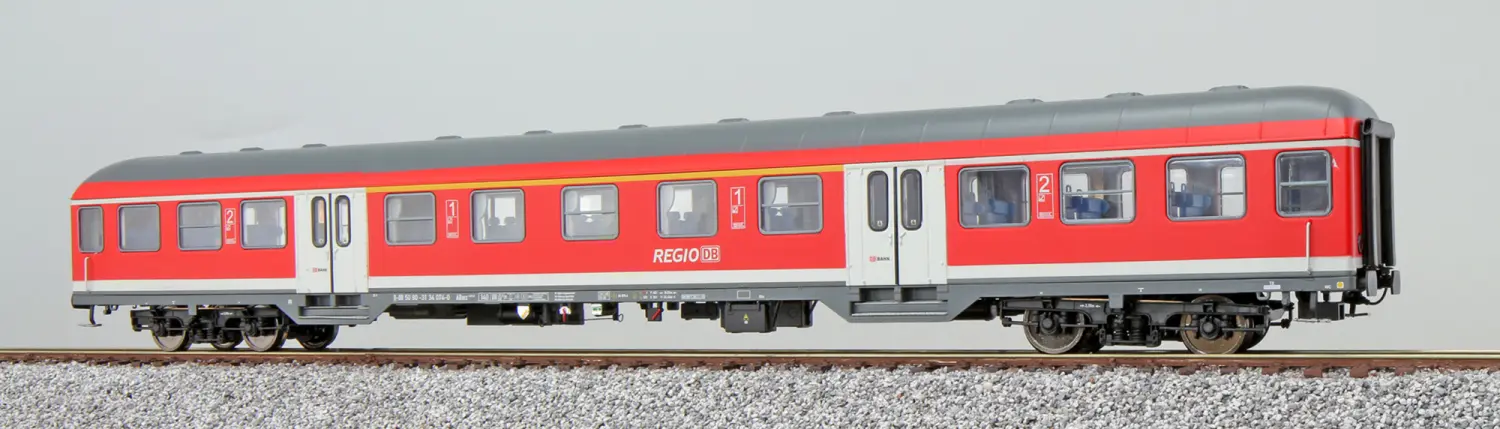
ABnrz418.4

Scale:
Markings:
Add
About the model
Pullman n-Wagen, H0, ABnrz418.4, 1st/2nd Class, DB Ep. VI, traffic
red, DC
NEW DESIGN n-Wagen
Prototype
For use in local transport but also to reinforce express trains, the Deutsche Bundesbahn (DB) procured a total of more than 4,800 cars in three basic floor plans between 1959 and 1977:
Pure 2nd class, 1st and 2nd class, as well as control cars with luggage and 2nd class large compartments.
The vehicle family was assigned the classification letter "n". A prototype car already featured the unpainted exterior responsible for the nickname "Silberlinge" with a brushed peacock eye pattern. The omission of paint reduced the weight by about two tons.
With a total weight between 27 and 30 tons, for example, the second-class cars were at least 5 tons lighter than the pre-war express train cars of the 1936 design. The initially installed axle generator type D62 limited the maximum speed to 120 km/h. The technically permissible 140 km/h could be achieved with a different axle generator design or by cars powered electrically from the traction vehicle. In 1969, the DB procured a total of 180 units of the Bnrzb724 design, which can be easily converted into ambulance cars in case of emergencies.
A notable difference from the previously manufactured cars is the nearly vertical roof closure ("steep roof"). The first control cars had a transition possibility at the driver's cab end to the next car, which is why the driver sat in a drafty small room ("rabbit box") to the right of the aisle. Starting in 1972, the DB received control cars with a modern "Karlsruhe head". To make local transport more attractive, the DB had several sets modernized internally and painted externally in pebble gray-orange starting in 1984, deploying them with a matching 218 under the product name City-Bahn.
The success of the product prompted the DB to modernize further cars from 1990 with newly upholstered seats, modified luggage racks, and a new exterior paint job. A variety of different variants of the types referred to as Re-Design-Wagen emerged, which were initially painted in the then-current mint turquoise-light gray. From 1993, the DB received control cars with a driver's cab side reminiscent of the VT 628, known as the "Wittenberger head".
In 2019, 60 years after the commissioning of the first Silberlinge, cars are still in daily use.
• Scale H0 models of the n-Wagen
• Multicolored interior design
• Separately inserted benches
• Spring-loaded bellows
• Freestanding grab poles
• Step plates at the ends of the cars and at the entrances as perforated etched parts
• Replication of smooth disc wheels
• Multi-part bogies with replication of block or disc brake systems
• Axle bearing plates and half-axles for friction-free eight-point current collection
• Simple retrofitting of the seating cars with an ESU interior lighting
• Coupling hook in a guide-controlled standard shaft
• Optional AC wheelset available under item no. 41200
• Minimum radius = 360 mm
• Length over buffers = 303 mm
...
NEW DESIGN n-Wagen
Prototype
For use in local transport but also to reinforce express trains, the Deutsche Bundesbahn (DB) procured a total of more than 4,800 cars in three basic floor plans between 1959 and 1977:
Pure 2nd class, 1st and 2nd class, as well as control cars with luggage and 2nd class large compartments.
The vehicle family was assigned the classification letter "n". A prototype car already featured the unpainted exterior responsible for the nickname "Silberlinge" with a brushed peacock eye pattern. The omission of paint reduced the weight by about two tons.
With a total weight between 27 and 30 tons, for example, the second-class cars were at least 5 tons lighter than the pre-war express train cars of the 1936 design. The initially installed axle generator type D62 limited the maximum speed to 120 km/h. The technically permissible 140 km/h could be achieved with a different axle generator design or by cars powered electrically from the traction vehicle. In 1969, the DB procured a total of 180 units of the Bnrzb724 design, which can be easily converted into ambulance cars in case of emergencies.
A notable difference from the previously manufactured cars is the nearly vertical roof closure ("steep roof"). The first control cars had a transition possibility at the driver's cab end to the next car, which is why the driver sat in a drafty small room ("rabbit box") to the right of the aisle. Starting in 1972, the DB received control cars with a modern "Karlsruhe head". To make local transport more attractive, the DB had several sets modernized internally and painted externally in pebble gray-orange starting in 1984, deploying them with a matching 218 under the product name City-Bahn.
The success of the product prompted the DB to modernize further cars from 1990 with newly upholstered seats, modified luggage racks, and a new exterior paint job. A variety of different variants of the types referred to as Re-Design-Wagen emerged, which were initially painted in the then-current mint turquoise-light gray. From 1993, the DB received control cars with a driver's cab side reminiscent of the VT 628, known as the "Wittenberger head".
In 2019, 60 years after the commissioning of the first Silberlinge, cars are still in daily use.
• Scale H0 models of the n-Wagen
• Multicolored interior design
• Separately inserted benches
• Spring-loaded bellows
• Freestanding grab poles
• Step plates at the ends of the cars and at the entrances as perforated etched parts
• Replication of smooth disc wheels
• Multi-part bogies with replication of block or disc brake systems
• Axle bearing plates and half-axles for friction-free eight-point current collection
• Simple retrofitting of the seating cars with an ESU interior lighting
• Coupling hook in a guide-controlled standard shaft
• Optional AC wheelset available under item no. 41200
• Minimum radius = 360 mm
• Length over buffers = 303 mm
Available article numbers:
ESU 36473
Technical specifications:

2-rail (direct current - DC)

Ready for interior lighting

Length over buffers
303 mm

Minimum drivable radius
360 mm
Advertising:

The identity card, photos and videos for thousands of railway vehicles all around Europe!
Copyright © 2026 T&H Services - All rights reserved
Powered by
