
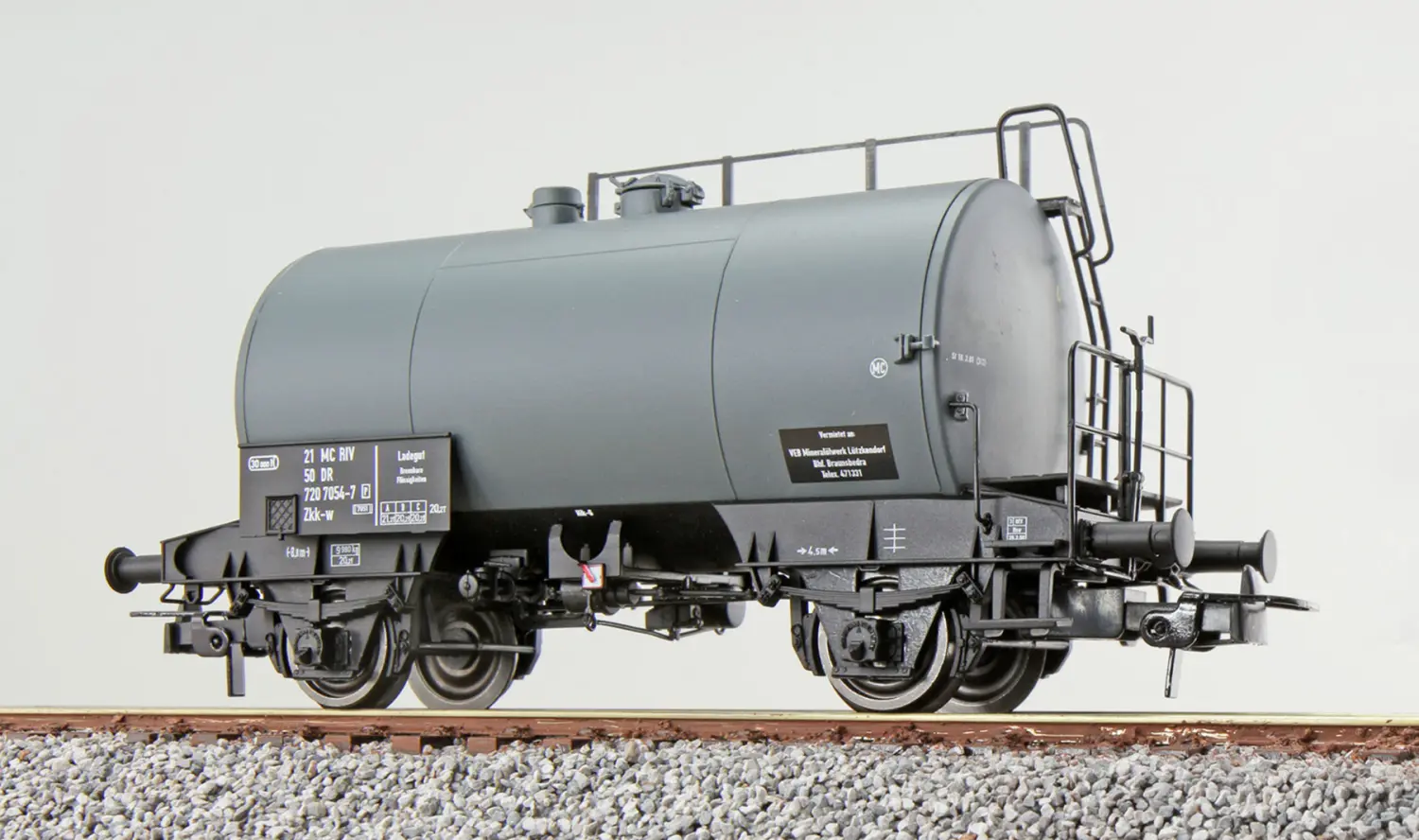
Bauart Deutz

Scale:
Markings:
Add
About the model
Kettle car, Deutz, 720 7 054-7, gray, DR, Ep IV, DC
Prototype
Even before the outbreak of World War II, the authorities recognized a significant need for tank cars for flammable liquids to secure supplies. The development was guided by the economical use of raw materials. Westwaggon in Cologne-Deutz developed a type under this guideline that did not have a separate underframe, where the end pieces were welded to the tank. Approximately 2000 units of the two-axle design, referred to as Deutzer Bauart after the developer's headquarters, were produced between 1941 and 1944. While the vehicles of the first series were delivered to private owners, military entities, such as the Luftwaffe, received the lion's share of subsequent deliveries. After World War II, the private cars remained with the successor companies of the oil associations, while the state-owned cars were transferred in 1951 to the Vereinigte Tanklager und Transportmittel GmbH VTG, founded on November 5, 1951. Private operators such as Shell, ESSO, ARAL, or Texaco in West Germany also used the Deutzer cars until the end of Ep IV. Many DR cars were rented to mineral oil companies. Several cars also remained abroad after World War II. By around 1990, the last examples were retired from service.
Model
• Scale model of the lightweight tank car with a capacity of 30 m³
• Running boards or walkways made from etched parts
• Various separately applied fittings
• Prototype-accurate dimensions for railings and grab bars made from durable plastic
• Epoch-appropriate design of the nameplates
• Profiled wheels on both sides
• Car weight 48 g for optimal running characteristics
• Axle tip bearing in metal bearings for smooth operation
• Coupling with non-magnetic hook in a guide-controlled standard pocket
• Minimum radius = 360 mm
• Length over buffers = 101.2 mm
...
Prototype
Even before the outbreak of World War II, the authorities recognized a significant need for tank cars for flammable liquids to secure supplies. The development was guided by the economical use of raw materials. Westwaggon in Cologne-Deutz developed a type under this guideline that did not have a separate underframe, where the end pieces were welded to the tank. Approximately 2000 units of the two-axle design, referred to as Deutzer Bauart after the developer's headquarters, were produced between 1941 and 1944. While the vehicles of the first series were delivered to private owners, military entities, such as the Luftwaffe, received the lion's share of subsequent deliveries. After World War II, the private cars remained with the successor companies of the oil associations, while the state-owned cars were transferred in 1951 to the Vereinigte Tanklager und Transportmittel GmbH VTG, founded on November 5, 1951. Private operators such as Shell, ESSO, ARAL, or Texaco in West Germany also used the Deutzer cars until the end of Ep IV. Many DR cars were rented to mineral oil companies. Several cars also remained abroad after World War II. By around 1990, the last examples were retired from service.
Model
• Scale model of the lightweight tank car with a capacity of 30 m³
• Running boards or walkways made from etched parts
• Various separately applied fittings
• Prototype-accurate dimensions for railings and grab bars made from durable plastic
• Epoch-appropriate design of the nameplates
• Profiled wheels on both sides
• Car weight 48 g for optimal running characteristics
• Axle tip bearing in metal bearings for smooth operation
• Coupling with non-magnetic hook in a guide-controlled standard pocket
• Minimum radius = 360 mm
• Length over buffers = 101.2 mm
Available article numbers:
ESU 36211
Technical specifications:

2-rail (direct current - DC)

Length over buffers
101.2 mm

Minimum drivable radius
360 mm
Advertising:

The identity card, photos and videos for thousands of railway vehicles all around Europe!
Copyright © 2026 T&H Services - All rights reserved
Powered by
