
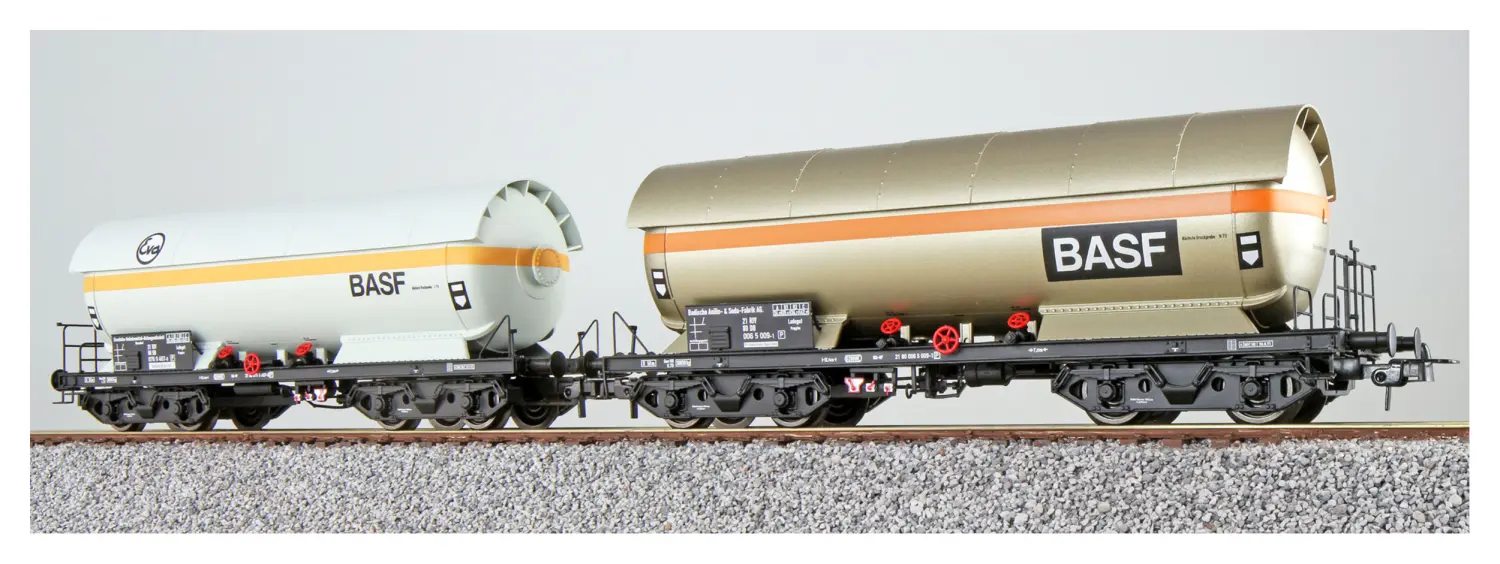
Bauart Zag

Scale:
Markings:
Add
About the model
Gas tank wagon set EVA 21 80 076 9 467-0 + BASF 21 80 006 5 009-1,
DB, white, Ep IV, DC
Prototype
To supply companies and households with liquefied gas for heating, various companies procured pressurized gas tank wagons. Since gas pipelines were not widely available until the 1980s, gas storage facilities were preferred in rural areas, which were served by rail and delivered liquefied gases such as propane or butane by truck to households. In wagon groups or as individual wagons, the pressurized gas tank wagons, initially marked with a yellow belly band and orange from the late 1960s, can be found in many freight trains on main and branch lines. Many companies in the chemical industry also required pressurized gas tank wagons for shipping their products, and thus the wagons often displayed large logos of their owner or lessee. In the early 1960s, gray-white or pebble gray increasingly replaced the previously common iron gray. Most four-axle designs featured the so-called bottom discharge, meaning the flanges and valves are located at the bottom of the tank.
The Zag design code indicates that the vehicle is a tank wagon (Z) with four or more wheelsets (a) for compressed, liquefied, or dissolved gases under pressure (g).
The Pullman model replicates a four-axle 620hl pressurized gas wagon from the Uerdingen wagon factory, primarily delivered to wagon lessors such as Eisenbahn Verkehrsmittel A.G. EVA. At the manufacturing plant, EVA was a partner that later merged into VTG. Characteristic of the Uerdingen wagons with the mounted sun protection roof was the comparatively large roof overhang with the radially extending distance plates. The central manhole on the non-handbrake end was common in new builds until about the mid-1960s.
Model
• H0 model of a pressurized gas tank wagon Zag with a capacity of 620 hl
• Perforated etched steps and running boards
• Separately applied details of the braking system
• Freestanding grab bars
• Etched nameplates with delicate mounting struts
• Freestanding coupling valves and shut-off devices
• Multi-part bogies of the Minden Dorstfeld design with freestanding rectangular hooks
• Profiled wheel discs on both sides
• Hook coupling in a guided standard pocket
• Optional AC wheelset available under item no. 41201
• Minimum radius = 360 mm
• Length over buffers = 145.7 mm
...
Prototype
To supply companies and households with liquefied gas for heating, various companies procured pressurized gas tank wagons. Since gas pipelines were not widely available until the 1980s, gas storage facilities were preferred in rural areas, which were served by rail and delivered liquefied gases such as propane or butane by truck to households. In wagon groups or as individual wagons, the pressurized gas tank wagons, initially marked with a yellow belly band and orange from the late 1960s, can be found in many freight trains on main and branch lines. Many companies in the chemical industry also required pressurized gas tank wagons for shipping their products, and thus the wagons often displayed large logos of their owner or lessee. In the early 1960s, gray-white or pebble gray increasingly replaced the previously common iron gray. Most four-axle designs featured the so-called bottom discharge, meaning the flanges and valves are located at the bottom of the tank.
The Zag design code indicates that the vehicle is a tank wagon (Z) with four or more wheelsets (a) for compressed, liquefied, or dissolved gases under pressure (g).
The Pullman model replicates a four-axle 620hl pressurized gas wagon from the Uerdingen wagon factory, primarily delivered to wagon lessors such as Eisenbahn Verkehrsmittel A.G. EVA. At the manufacturing plant, EVA was a partner that later merged into VTG. Characteristic of the Uerdingen wagons with the mounted sun protection roof was the comparatively large roof overhang with the radially extending distance plates. The central manhole on the non-handbrake end was common in new builds until about the mid-1960s.
Model
• H0 model of a pressurized gas tank wagon Zag with a capacity of 620 hl
• Perforated etched steps and running boards
• Separately applied details of the braking system
• Freestanding grab bars
• Etched nameplates with delicate mounting struts
• Freestanding coupling valves and shut-off devices
• Multi-part bogies of the Minden Dorstfeld design with freestanding rectangular hooks
• Profiled wheel discs on both sides
• Hook coupling in a guided standard pocket
• Optional AC wheelset available under item no. 41201
• Minimum radius = 360 mm
• Length over buffers = 145.7 mm
Available article numbers:
ESU 36523
Technical specifications:

2-rail (direct current - DC)

Length over buffers
145.7 mm

Minimum drivable radius
360 mm
Advertising:

The identity card, photos and videos for thousands of railway vehicles all around Europe!
Copyright © 2026 T&H Services - All rights reserved
Powered by
