
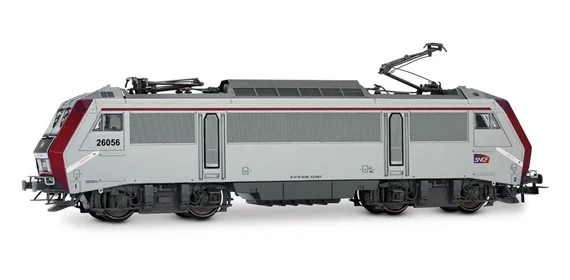
SNCF - electric locomotive BB 26056

Scale:
Markings:
Add
About the model
The BB 26000, designed as a universal locomotive, is capable of
hauling a 750-ton passenger train at 200 km/h on a gradient of 2
mm/m or a 2000-ton freight train on a gradient of 8 mm/m under the
two types of current available in France. The BB 26000 represents a
renewal of the SNCF's electric locomotive fleet, both technically
through the use of synchronous motors instead of series DC motors
and aesthetically with a more aerodynamic body than that of the
previous generation of locomotives known as "broken noses" (CC 6500
and BB 7200/15000/22200). The locomotives, built between 1988 and
1998 in 234 units, are known as BB 26000 or SYBIC (acronym for
Synchronous Bicourant) with a power output of 5600 kW and can
quickly be deployed for the traction of passenger trains at a speed
of 200 km/h on the TER200 lines in Alsace
(Strasbourg-Mulhouse-Basel) and InterLoire (Orléans-Tours-Nantes),
as well as on the axes Paris-Orléans-Limoges-Toulouse and
Paris-Cherbourg. The SYBICs are also used for the traction of
freight trains between the northeast and southeast, allowing the
SNCF to retire older electric locomotive classes (CC 7100, BB 8100,
BB 9400, BB 12000, BB 13000, CC 14000, and CC 14100). All BB 26000
locomotives were originally painted in a two-tone gray livery with
an orange stripe on the front ends and the top of the body. BB
26172 in "Carmillon" livery is part of the collection at the Cité
du Train museum in Mulhouse. Starting from BB 26188, the SYBICs
received a third front light in accordance with European
regulations to avoid confusion with road vehicles. The "Cap" logo
introduced in 1995 is always located on the right side. BB 26212
was put into service on October 17, 1996.
...
Catalogs / brochures
Available article numbers:
Jouef HJ2444
Technical specifications:

2-rail (direct current - DC)

5-pole motor

Coupler standard pocket (NEM 362)

Coupler with close coupling cinematic

Double headlights alternating with the direction of travel

Length over buffers
204 mm

Minimum drivable radius
356.5 mm
Show more
Jouef HJ2444S
Technical specifications:
2-rail (direct current - DC)

DCC (Digital)
5-pole motor

Integrated sound
Coupler standard pocket (NEM 362)
Coupler with close coupling cinematic
Double headlights alternating with the direction of travel
Length over buffers
204 mm
Minimum drivable radius
356.5 mm
Show more
Advertising:

The identity card, photos and videos for thousands of railway vehicles all around Europe!
Copyright © 2026 T&H Services - All rights reserved
Powered by
