
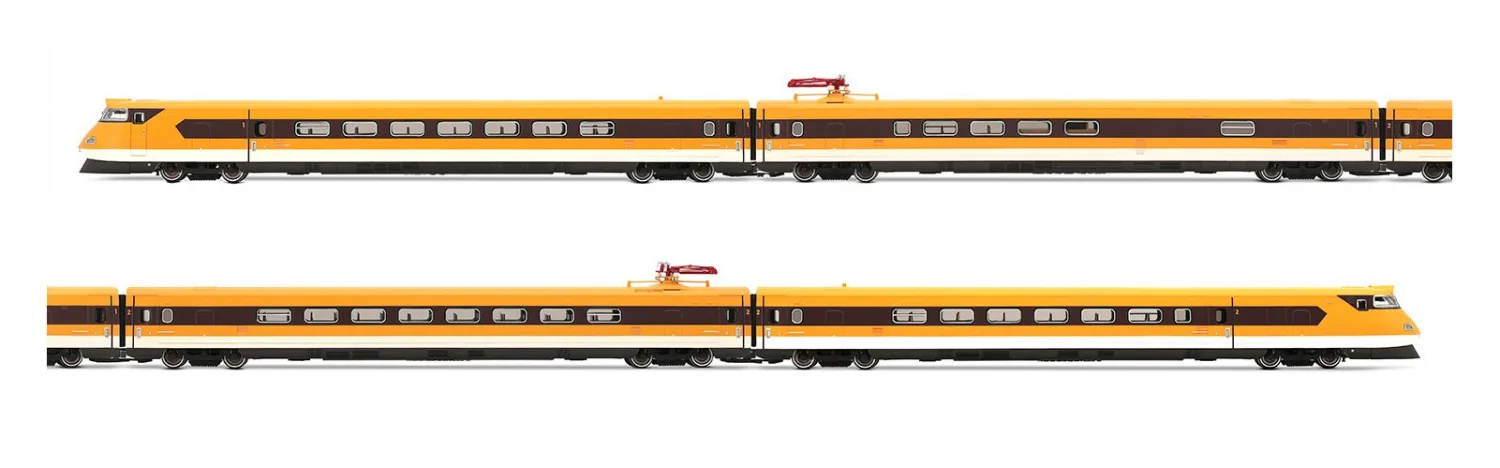
RENFE - tilting high-speed EMU class 443

Scale:
Markings:
Add
About the model
The Electrotrén Basculante 443, better known as "Platanito," was
Spain's first encounter with high speed. Its Italian counterpart,
designed to increase speed on curves, utilized the so-called Active
Tilting, a groundbreaking technology that involved tilting the car
bodies in curves to enhance train speed while maintaining passenger
comfort. Amazed by the results of the Italian prototype, RENFE's
management decided in the late 1970s to request a prototype adapted
to the Spanish network, which was delivered in 1976. The
"Platanito" reached a speed of 200 km/h in its first year of
testing and traveled extensively across our country, even being
commercially operated on several lines of the national network. For
years, it held the speed record in Spain at 206.8 km/h.
Unfortunately, it suffered a breakdown during these tests from
which it could not recover. The lack of spare parts and the
associated costs, as it was a one-off, led to its decommissioning.
Since then, it has remained in the Fuencarral depot with an
uncertain fate, until the signing of a scrapping order.
Fortunately, it was saved and has been on one of the tracks at the
Castejón de Ebro station since 1994, under the selfless care of a
group of volunteers who continue to look after it. Such a popular
and unique vehicle deserves to be replicated and to run on
enthusiasts' models. This is our way of paying tribute to this
mythical automobile. And the fact is that the "Platanito" is, above
all, just like us, an Electrotren.
Model features:
- Couplings with electrical connections between the cars.
- 5-pole motor with flywheels.
- Metal chassis for all cars.
- Detailed interior.
- White or red lighting depending on the direction of travel.
- Interior lighting.
- Digital control of exterior and interior lighting.
- 21-pin MTC connector (NEM660).
- Fine and robust metal pantographs with various designs depending on the era.
- Length between ends: 1230 mm.
- Minimum radius: 356.5 mm.
...
Model features:
- Couplings with electrical connections between the cars.
- 5-pole motor with flywheels.
- Metal chassis for all cars.
- Detailed interior.
- White or red lighting depending on the direction of travel.
- Interior lighting.
- Digital control of exterior and interior lighting.
- 21-pin MTC connector (NEM660).
- Fine and robust metal pantographs with various designs depending on the era.
- Length between ends: 1230 mm.
- Minimum radius: 356.5 mm.
Catalogs / brochures
Available article numbers:
Electrotren HE2017
Technical specifications:

2-rail (direct current - DC)

DCC (Digital)

5-pole motor

Flywheel drive

21-pin interface (NEM 660)

Coupler with close coupling cinematic

Triple headlights and two taillights alternating with the direction of travel
Two red taillights

Interior LED lighting

Can be switched over to overhead line operation

Locomotive - body chiefly made of metal

With interior fittings

Length over buffers
1220 mm

Minimum drivable radius
356.5 mm
Show more
Electrotren HE2017S
Technical specifications:
2-rail (direct current - DC)
DCC (Digital)
Flywheel drive
5-pole motor
21-pin interface (NEM 660)

Integrated sound
Coupler with close coupling cinematic
Triple headlights and two taillights alternating with the direction of travel
Two red taillights
Interior LED lighting
Can be switched over to overhead line operation
Locomotive - body chiefly made of metal
With interior fittings
Length over buffers
1220 mm
Minimum drivable radius
356.5 mm
Show more
Advertising:

The identity card, photos and videos for thousands of railway vehicles all around Europe!
Copyright © 2026 T&H Services - All rights reserved
Powered by
