
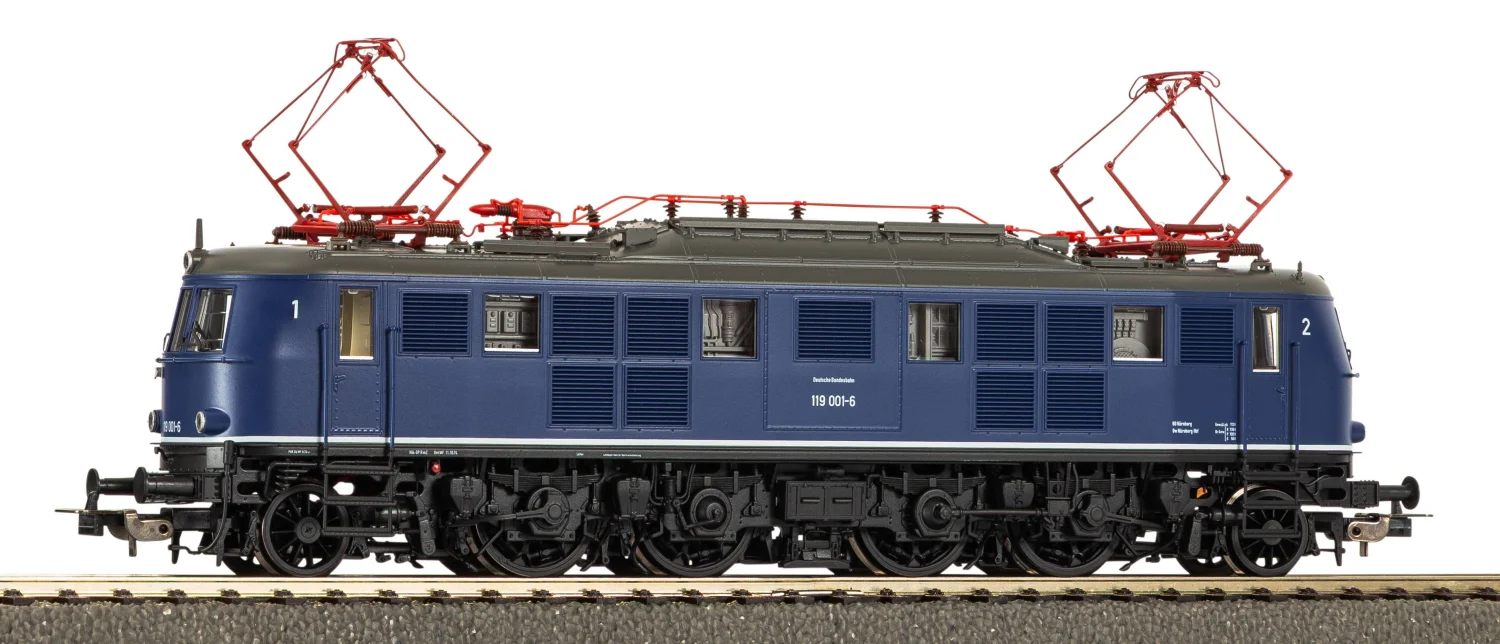
DB - Elektrolokomotive BR 119

Scale:
H0 / HO (1:87)
Vehicle information:
119 001-6
About the model
Novelty 2026: Elegance and Power at High Speed – the E 19 Class
For the revolution of rail transport by the Deutsche Reichsbahn at the end of the 1930s, the E 19 class was developed as one of the fastest and most elegant electric locomotives of its time. Designed for operation on the fully electrified Berlin – Halle (Saale) – Munich route, a top speed of 180 km/h was planned, with reserves for over 200 km/h. On the steep ramps of the Franconian Forest, it was still expected to reach 60 km/h. In 1937, two prototypes (E 19 01 and 02) were built by AEG, followed in 1939 by two more from Siemens-Schuckert and Henschel. Both types were based on the proven E 18, adopting its successful spring-mounted motor drive and the rigid frame with wheel arrangement 1’Do1’. The visible differences were mainly the modified fan and window arrangement. Innovative design elements were also introduced: the body panels were welded instead of riveted, and a modified fine regulator ensured smoother switching. Its motor output increased by around 500 kW, complemented by improved suspension, reinforced brakes, and an electric dynamic brake, which enhanced safety at 180 km/h. After World War II, the Deutsche Bundesbahn took over all four locomotives. Stationed at Bw Nürnberg, they hauled express trains through the Franconian Forest and from Nuremberg to Regensburg. From 1968, they were based at Bw Hagen-Eckesy and were subsequently reclassified as Class 119. With the retirement of the last locomotive, E 19 002, in 1978, active service ended. Today, E 19 01 is preserved as an impressive testimony to German electric locomotive history.
Version with typical stem lamps of Era IV and delicate SBS 39/54 pantographs | With fine handrails, UIC sockets, and additional centrifugal regulator | Extra sandboxes, axle bearing covers, and battery boxes | Separately attached windshield wipers, roof lines, and insulators | In digital operation with switchable cab and control panel lighting
...
For the revolution of rail transport by the Deutsche Reichsbahn at the end of the 1930s, the E 19 class was developed as one of the fastest and most elegant electric locomotives of its time. Designed for operation on the fully electrified Berlin – Halle (Saale) – Munich route, a top speed of 180 km/h was planned, with reserves for over 200 km/h. On the steep ramps of the Franconian Forest, it was still expected to reach 60 km/h. In 1937, two prototypes (E 19 01 and 02) were built by AEG, followed in 1939 by two more from Siemens-Schuckert and Henschel. Both types were based on the proven E 18, adopting its successful spring-mounted motor drive and the rigid frame with wheel arrangement 1’Do1’. The visible differences were mainly the modified fan and window arrangement. Innovative design elements were also introduced: the body panels were welded instead of riveted, and a modified fine regulator ensured smoother switching. Its motor output increased by around 500 kW, complemented by improved suspension, reinforced brakes, and an electric dynamic brake, which enhanced safety at 180 km/h. After World War II, the Deutsche Bundesbahn took over all four locomotives. Stationed at Bw Nürnberg, they hauled express trains through the Franconian Forest and from Nuremberg to Regensburg. From 1968, they were based at Bw Hagen-Eckesy and were subsequently reclassified as Class 119. With the retirement of the last locomotive, E 19 002, in 1978, active service ended. Today, E 19 01 is preserved as an impressive testimony to German electric locomotive history.
Version with typical stem lamps of Era IV and delicate SBS 39/54 pantographs | With fine handrails, UIC sockets, and additional centrifugal regulator | Extra sandboxes, axle bearing covers, and battery boxes | Separately attached windshield wipers, roof lines, and insulators | In digital operation with switchable cab and control panel lighting
Catalogs / brochures
Available article numbers:
PIKO 21060
Available since: August 2026
Technical specifications:

2-rail (direct current - DC)

PluX22 interface (NEM 658)

Number of axles with traction tyres
2

Coupler standard pocket (NEM 362)

Coupler with close coupling cinematic
Two red taillights

With interior fittings

Length over buffers
195 mm

Minimum drivable radius
358 mm
Show more
PIKO 21062
Available since: August 2026
Technical specifications:
2-rail (direct current - DC)

DCC (Digital)
PluX22 interface (NEM 658)

Integrated sound
Number of axles with traction tyres
2
Coupler standard pocket (NEM 362)
Coupler with close coupling cinematic
Two red taillights
With interior fittings
Length over buffers
224 mm
Minimum drivable radius
358 mm
Show more
PIKO 21063
Available since: August 2026
Technical specifications:

3-rail (alternating current - AC)
DCC (Digital)
PluX22 interface (NEM 658)
Integrated sound
Number of axles with traction tyres
2
Coupler standard pocket (NEM 362)
Coupler with close coupling cinematic
Two red taillights
With interior fittings
Length over buffers
195 mm
Minimum drivable radius
358 mm
Show more
Discussion forum
Advertising:

The identity card, photos and videos for thousands of railway vehicles all around Europe!
Copyright © 2026 T&H Services - All rights reserved
Powered by
