

Source: Thomas Eckhardt
Also known as: BR 215 / V 168
UIC / EVN numbering: 92 80 1215
Vehicle type: Diesel locomotive
Registration country: Germany
Railway companies: DB - Deutsche BahnDB - Deutsche Bundesbahn
1968
To bridge this technological and operational gap, DB opted for an interim solution: a lengthened version of the V 160 family. In 1968, a new "long V 160" type was developed based on the V 162 (later BR 217) / V 164 (later BR 218). This locomotive was around 400 mm longer, allowing the installation of more powerful engines. Initially designated V 168, it was renumbered Class 215 (BR 215) upon delivery under the new EDV1 system.
The first ten locomotives, registered 215 001 - 010, built by Krupp, served as pre-series test units. Although they retained steam heating using Vapor boilers, space was reserved for later conversion to electric train heating. These locomotives were primarily intended to test higher-power diesel engines.
1The EDV system refers to Elektronische Datenverarbeitung (German for Electronic Data Processing), a computer-based numbering and classification system introduced by Deutsche Bundesbahn in 1968, on January 1st, to standardize locomotive, coach and wagon numbers so they could be processed reliably by computers.
1969
Two main engine types were used:
the pre-series locomotives 215 001–010, as well as series units 215 071–093, were equipped with MAN 12 V 956 TB 10 engines rated at 1,839 kW;
locomotives 215 011–070 and 215 094–150 received 16-cylinder 16 V 652 TB 10 engines with an output of 1,397 kW.
Do you have additional informations regarding this vehicle?
Help us writing the history of Class 215! Your knowledge is precious for us and the entire community, do not hesitate to share your facts, photos or videos:
Latest update on the 31st of December 2025 at 15:06
Contributor(s): Tudor C.
Advertising:
Class 215 - Related rolling stock from category "DB - V 160 diesel locomotives":


Class 215 - Associated miniature models:
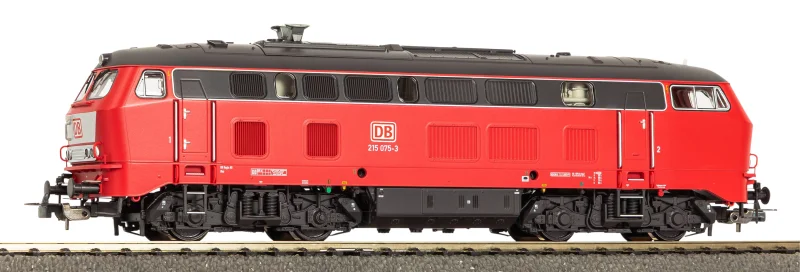
DB - Diesellokomotive BR 215
Recommended retail price: from 199,00 €
Advertising:

The identity card, photos and videos for thousands of railway vehicles all around Europe!
