
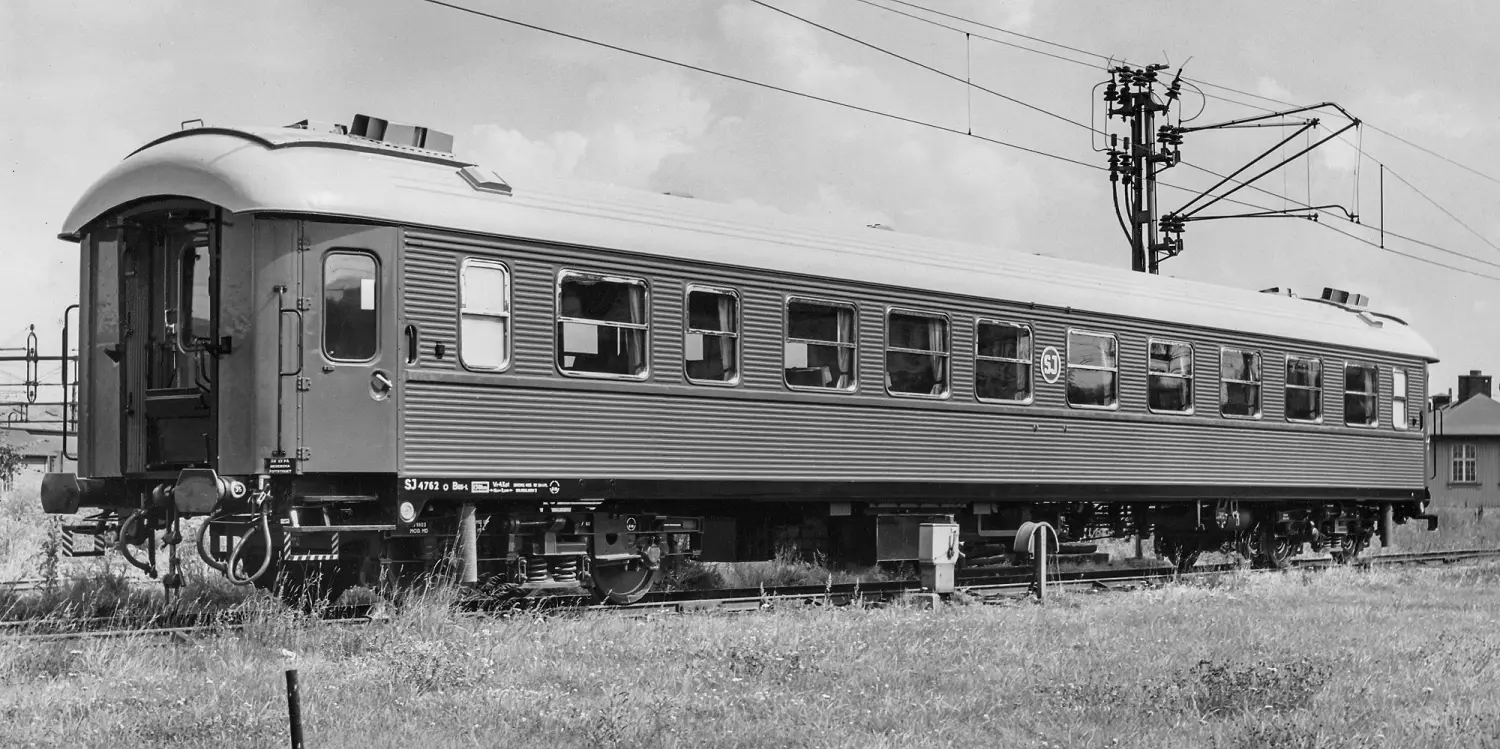
Vehicle type: regular coach
Registration country: Sweden
Railway companies: NetRailVEO - Snälltåget / Veolia TransportSJ - Statens Järnvägar
1960s
At delivery, the classification on the cars was Bo5 for the standard version and Bo5b for cars with children's compartments, which was changed during the 1970 SJ's classification reform to B5 and B5B.
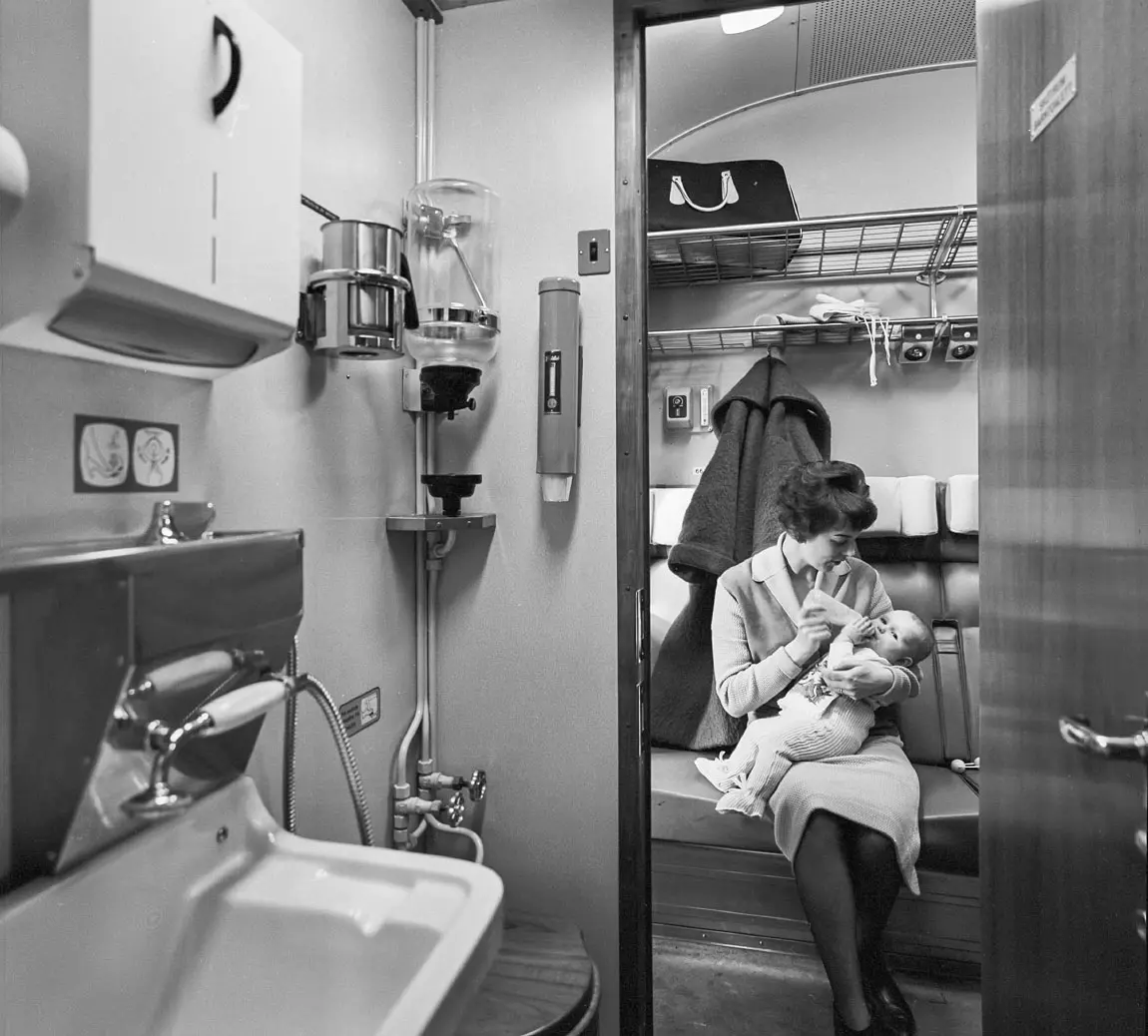
30 of these cars (numbers 4983-5012) were equipped with children's compartments that had a shared changing room and space for four seats and resting places for children. During the modernization in the late 1980s, the children's compartments were removed, and one of the toilets was remodeled to include a changing table. After the renovation, the classification remained B5B, but it now indicated that the car had a ticket machine.
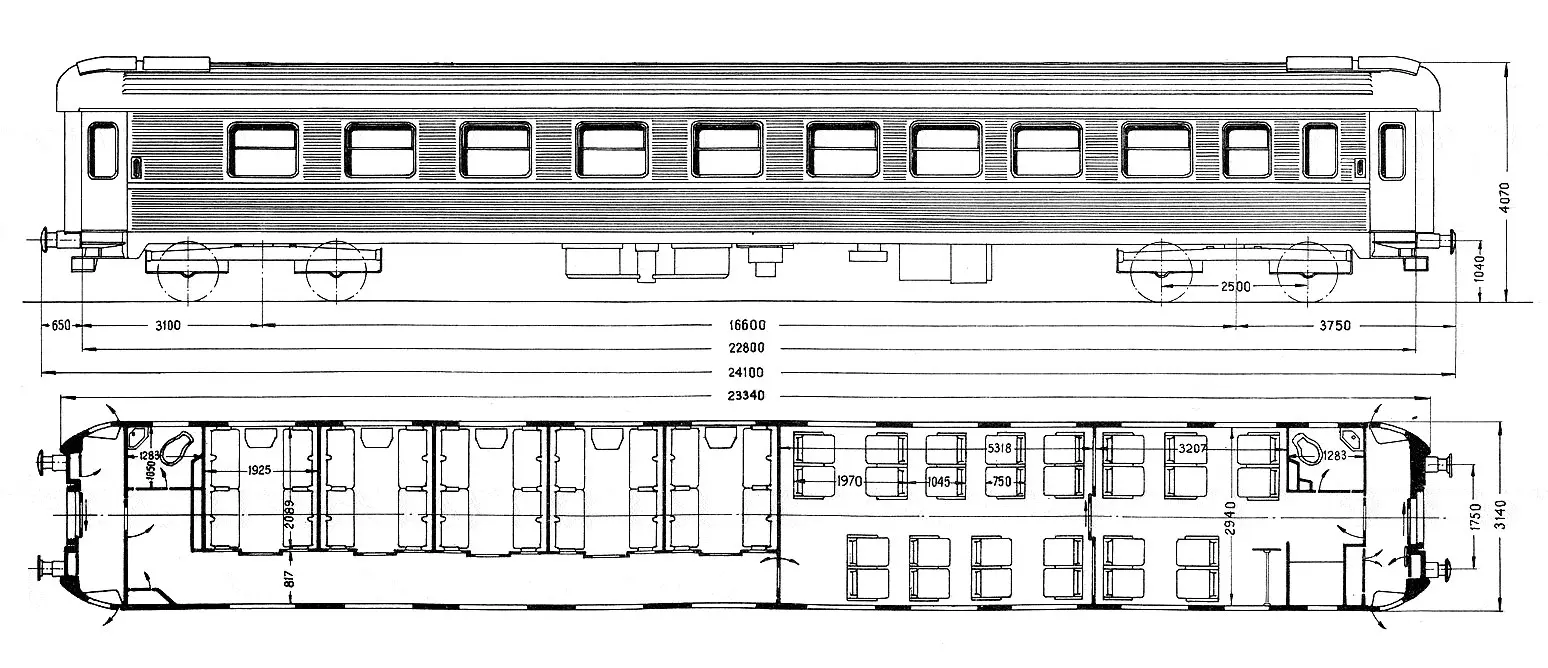
The B5 cars, like other 1960s cars, initially had asbestos insulation, which was common in the 1960s when the health risks were not known. By the late 1980s, most B5 cars underwent asbestos remediation and modernization, where the interior was refreshed and toilets were remodeled. The compartments received individual seats that reduced the seating from eight to six, and the compartment closest to the vestibule was converted into a service compartment for train staff.
The car originally had a brown color scheme, but during the 1990s, they were repainted in SJ's new blue color scheme, which exists in three versions.
In the early 1980s, three cars were rebuilt to include a base compartment for a mobile service car, equipped with a coffee maker and refrigerator. These cars were first designated B5G, which was changed to B5S in 1985, before they became regular passenger cars in 1991. Between 1991 and 1992, an additional 16 cars were converted with a service compartment and service compartment, resulting in the designation BS5. In 2002, the service compartments in some of the cars were closed, which regained the designation B15.
SJ sold eight B5 cars to railways in Bosnia and Croatia in 1999, and several of these were reportedly in traffic until the end of the 2010s. The train company rented some B5 cars between 2000 and 2003 for traffic to upper Norrland and the Malmbanan. Connex (later Veolia) took over the traffic in June 2003 and continued to rent the cars until 2007. The rental was managed from 2004 by the Business Authority Statens Järnvägar (SSRT).
Fifteen B5 cars that had not undergone asbestos remediation were scrapped in 1993, and the remaining cars were gradually scrapped as the need decreased. In 2001, about 40 cars remained in traffic, but in 2004, SJ initiated a large-scale phasing out of 1960s cars, which led to the last B5 cars being retired in January 2006. In 2007, four B5 cars were purchased from SSRT by NetRail, a company specializing in the rental and sale of railway vehicles. Some of these cars were rented out to Scandinavian Rail for traffic between Stockholm and Oslo under the name Unionsexpressen, but the traffic ceased in October 2008 after the operator Ofotbanen AS had its permit revoked.
From 2009, Veolia Transport rented several of the cars for use in their trains Malmö-Stockholm, where the cars were equipped with power outlets and Wi-Fi. Car B5 4743 was rebuilt with a service compartment but retained its designation for a while. In 2013, Netrail sold the four cars to Skandinaviska Jernbanor/Blå Tåget (numbers 4743, 4750, and 4757) and one to Veolia/Snälltåget (4762), but Snälltåget's car was retired and scrapped in 2014. Blå Tåget also purchased an earlier museum car, B5 5007. Tågab owns a B5 car (5128) as well as several BS5, and Kraftdragarna has one car, B5 4765, used as a staff car. Both the Railway Museum and Nässjö Railway Museum have B5 cars as museum cars.
Sources: https://www.jarnvag.net/vagnguide/b5
Do you have additional informations regarding this vehicle?
Help us writing the history of B5! Your knowledge is precious for us and the entire community, do not hesitate to share your facts, photos or videos:
Latest update on the 10th of August 2025 at 17:29
Contributor(s): Tudor C.
Advertising:
B5 - Associated miniature models:

SJ - AB3 & B5 passenger coaches set
Recommended retail price: 229,00 €
Advertising:

The identity card, photos and videos for thousands of railway vehicles all around Europe!
