
Source: Donautalbahner
Vehicle type: Electric multiple unit - EMU
Registration country: France
Railway companies: SNCF - Société Nationale des Chemins de Fer français
1980s
The requirement was clear: SNCF needed a "Network" ("Réseau") train. It had to be shorter (200 meters) to allow for "double-unit" operations (two trains coupled together) while still fitting within the standard 400-meter platform limit of European stations. It also had to be more versatile, capable of running anywhere in France and crossing into neighboring countries.
The TGV Réseau was not a clean-sheet design but rather a refined, optimized evolution of the TGV Atlantique:
the power cars: while they looked identical to the TGV Atlantique power cars, the TGV Réseau units featured upgraded electronics and traction motors; they were designed to maintain a commercial speed of 300 km/h (and later 320 km/h) with 8 trailers instead of 10, giving them a superior power-to-weight ratio.
pressure sealing: One of the most significant technical leaps was the introduction of integral pressure sealing. As the high-speed network expanded into the rugged terrain of the South and North, trains were encountering tunnels at 300 km/h. The sudden change in air pressure caused significant ear discomfort for passengers. The TGV Réseau trailers were the first in the TGV family to be fully sealed, maintaining a stable internal atmosphere even during high-speed tunnel entries.
braking systems: To handle the increased frequency of stops on the denser Northern and Eastern networks, the braking systems were reinforced, featuring high-performance kinetic energy dissipation.
The most ambitious part of the Réseau project was the Tricourant (Triple-voltage) version. While the standard Bicourant units (Series 500) operated on French 25 kV AC and 1.5 kV DC, the Series 4500 was designed for international expansion.
Engineers had to integrate equipment for 3'000 V DC, the standard in Belgium and Italy. This required a complex arrangement of pantographs and transformers within the limited space of the power car. This technical foresight laid the groundwork for the Thalys and the Artésia (Paris-Milan) services, making the TGV Réseau the first truly "European" TGV.
1992
50 Bicourant sets (501 - 550): Intended to replace aging Corail trains and provide the backbone of the new LGV Nord.
40 Tricourant sets (4501 - 4540): Intended for international routes, with 10 of these eventually earmarked for the Paris-Brussels-Amsterdam (PBA) corridor (TGV PBA 4531 - 4540).
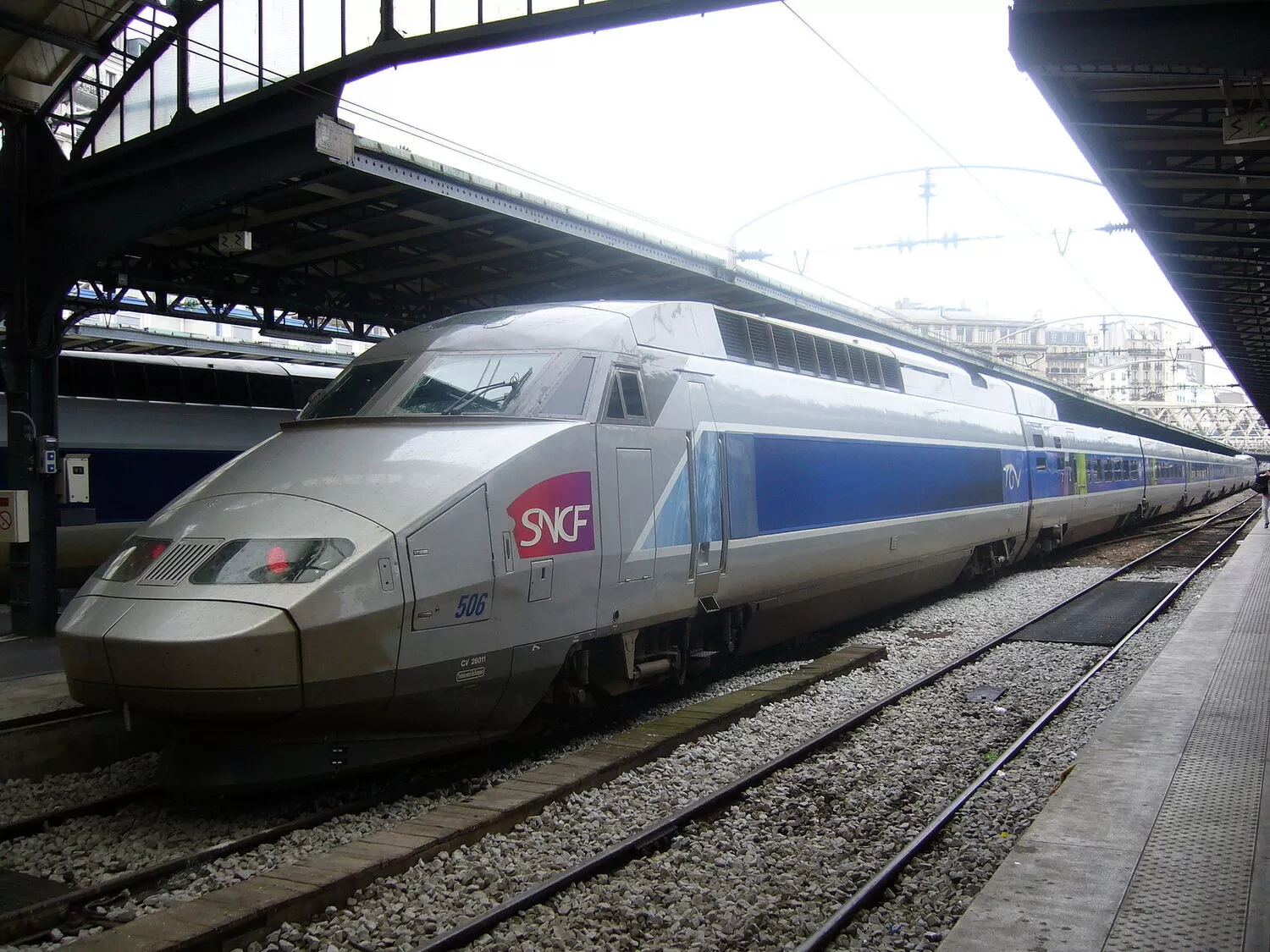
The first test runs were conducted in late 1992, with the sets dressed in the classic "Atlantique Blue" livery - a silver-grey body with a high-contrast blue window band, symbolizing the modern era of the SNCF.
1995
While the partnership began in 1995, the first TGV Réseau units did not enter commercial service to Milan until September 29th, 1996. This date marked the restoration of direct daytime rail links between Paris and Milan, which had been suspended since 1984. Six specific sets were assigned to this service: TGV Réseau 4501 - 4506. In SNCF technical documents, they were nicknamed the "PLT" sets (Paris-Lyon-Turin).
Following the tradition of great European expresses, the two daily round-trips were given names:
EC Alexandre Dumas (Paris Gare de Lyon - Torino - Milano Centrale);
EC Alessandro Manzoni (Paris Gare de Lyon - Torino - Milano Centrale).
Operating in Italy required the 4500 series to undergo specific technical modifications that set them apart from the rest of the TGV Réseau fleet:
Voltage: Capable of running under 3,000V DC, the standard on the Italian classic network.
Signaling: Equipped with the RS4 Codici (and later SCMT) signaling system, essential for crossing the border at Modane and navigating the Italian rail network.
Pantographs: Unlike the standard GPU pantographs used for French AC lines, these units were fitted with Cx type pantographs optimized for the Italian 3'000V DC catenary.
Braking: Reinforced high-energy dissipation systems were utilized to handle the long, steep descents on the Maurienne line (Alps) during the crossing between France and Italy.
The Artesia brand disappeared on November 14th, 2011. The dissolution followed the SNCF's decision to invest in Nuovo Trasporto Viaggiatori (NTV), a direct competitor to Trenitalia.
After 2011, SNCF continued to operate the Paris - Milan route independently under the brand SNCF Voyages Italia using the same TGV Réseau sets, while Trenitalia focused on night services via a new joint venture: Thello.
Sources: https://en.wikipedia.org/wiki/Artesia_(railways), https://trains-en-voyage.com/dossiers/ceh/paris_lyon_milano.htm, http://actgv.fr/wp-content/uploads/2012/05/TGV-tri.pdf, https://www.railpassion.fr/materiel-actualites-rp/rames-tgv-paris-milan-prolongees/
1996
2001
May 26
On the afternoon of May 26th, 2001, TGV Réseau set 531 (a standard Bicourant unit) departed from Calais-Fréthun station in the north of France. Its destination was Marseille Saint-Charles in the south.
Distance: 1,067.2 km (663.1 miles).
Total time: 3 hours, 29 minutes and 30 seconds.
Average speed: 306,37 km/h over the entire distance.
Maximum speed: The train reached a peak speed of 366,6 km/h during the journey.
This was not merely a speed test but a demonstration of sustained high-speed endurance. It set a world record for the longest non-stop run by a commercial high-speed trainset. The run proved the effectiveness of the TGV Réseau's integral pressure sealing, which allowed the train to maintain these speeds through the numerous tunnels of the new LGV Méditerranée without causing discomfort to the passengers (a group of journalists and SNCF officials, including SNCF's President Louis Gallois).
Sources: http://www.sterlingot.com/TGV/pdf/dossier-presse-operation-sardine.pdf, https://www.google.com/search?q=https://fr.wikipedia.org/wiki/Records_du_monde_de_vitesse_sur_rail_en_France%23Op%25C3%25A9ration_Sardine, https://www.lettreducheminot.fr/il-etait-une-fois-dans-la-vie-du-rail/etait-vie-rail-63operation-sardine-calais-marseille-record/, https://www.youtube.com/watch?v=m8B0hZaR-cI
2004
Following the public design competition in 2002, the Christian Lacroix vision was implemented across the TGV Réseau 500 series (Bicourant) fleet. The renovation was industrially managed at the Technicentre d'Hellemmes near Lille, which specialized in heavy TGV overhauls.
Christian Lacroix, a renowned fashion designer, moved away from the "industrial grey" of the 1990s:
Color-Coded Interiors: The concept used colors to define the atmosphere. Vibrant Red was used for 2nd Class to signify energy and dynamism, while Apple Green (Chartreuse) was used for 1st Class to create a sense of calm and luxury.
The "Wrap-Around" Seat: The seats were redesigned with wide, curved headrests to provide better privacy for passengers, a feature that became the signature of the Lacroix interior.
The Bar Coach: The Bar (Coach 4) was entirely reimagined with high-gloss surfaces, neon lighting, and standing areas designed to foster social interaction.
The renovation was not purely cosmetic; it addressed the growing digital needs of travelers:
Electrical Outlets: For the first time, 220V power outlets were installed at every seat in 1st Class and at most "Club" seats in 2nd Class, allowing passengers to charge laptops and early smartphones.
Modernized Information Systems: New digital displays were integrated into the coach ends to provide real-time speed, destination, and station stop information.
Weight Reduction: The use of new materials in the seating and flooring helped offset the weight of the additional electrical equipment, maintaining the train's performance profile.
To match the interior, the exterior was refreshed:
The "Atlantique Blue" window band was retained, but the rest of the train was painted in a bright silver-grey.
The coach doors received bold, vertical color splashes corresponding to the class inside (Red/Green).
A reflective silver stripe was added along the length of the train to enhance its silhouette at night and signify "speed."
The rollout was executed at a rate of roughly one trainset every three weeks. The process involved stripping the trailers down to the metal frame, verifying the integrity of the pressure sealing, and then installing the entirely new interior modules.
2006
Sets 551, 552 and 553:
As the TGV POS project required 19 trailer sections from the Bicourant (TGV Réseau 500) series, SNCF found itself with a surplus of Triple-voltage (TGV Réseau 4500) trailers that were no longer needed for international service. To optimize the fleet, they decided to "downgrade" three Triple-voltage trailer sections and pair them with Bicourant power cars:
Set 551: Created by pairing the power cars of the original Set 527 with the trailer section of the Triple-voltage Set 4507. The trailers were technically modified to operate as Bicourant (25kV/1.5kV).
Set 552: Created using the power cars of the original Set 528 and the trailer section of Set 4508.
Set 553: A set of historical significance, it was formed using the power cars of the original Set 531 (the 2001 endurance record-holder) and the trailers from Set 4509.
Set 554:
Unlike the 551 - 553 units, which were intended for long-term service, 554 units was a temporary formation used to cover maintenance gaps and test the compatibility of mixed-component rames during the transition. It utilized power cars from Set 533 and various spare trailers. Shortly after its formation, it was dismantled. Its power cars were sent to be paired with brand-new Duplex trailers to become the TGV Réseau Duplex Set 615. In 2021, as part of the fleet reorganization, the Set 554 is revived for a permanent new formation: power cars 28021/28022 (originally from Set 511, ex-Réseau Duplex) are paired with single-deck trailers from the TGV POS program.
Also in 2006, unit TGV Réseau 4530 is permanently removed from passenger service to become the TGV IRIS 320 ("Information de Recherche et d’Inspection").
2008
During this period, set TGV PBA 4531 was officially removed from the Thalys pool, stripped of its maroon livery and returned to SNCF domestic service as set TGV Réseau 4551.
2011
The TGV Réseau sets were among the first to receive this paint scheme during their "Operation Caisse" (bodywork maintenance) cycles.
2015
2017
With more TGV Duplex units taking over high-capacity routes to the Mediterranean, the TGV Réseau became the specialist for Inter-sector services (linking regional hubs without stopping in Paris) and routes to Luxembourg and Lille.
2021
SNCF ends the "hybrid" TGV Réseau Duplex program. Power cars from Set 601 are separated from the double-deck trailers. These power cars are mated with the 8 single-deck trailers from the former TGV POS 4401 (which were originally built for the Réseau series). The set is officially registered as Set 560 to avoid confusion with the original Set 515.
Do you have additional informations regarding this vehicle?
Help us writing the history of TGV Réseau! Your knowledge is precious for us and the entire community, do not hesitate to share your facts, photos or videos:
Latest update on the 9th of January 2026 at 21:50
Contributor(s): Tudor C.
Advertising:
TGV Réseau - Related rolling stock from category "TGV":


Advertising:

The identity card, photos and videos for thousands of railway vehicles all around Europe!
