
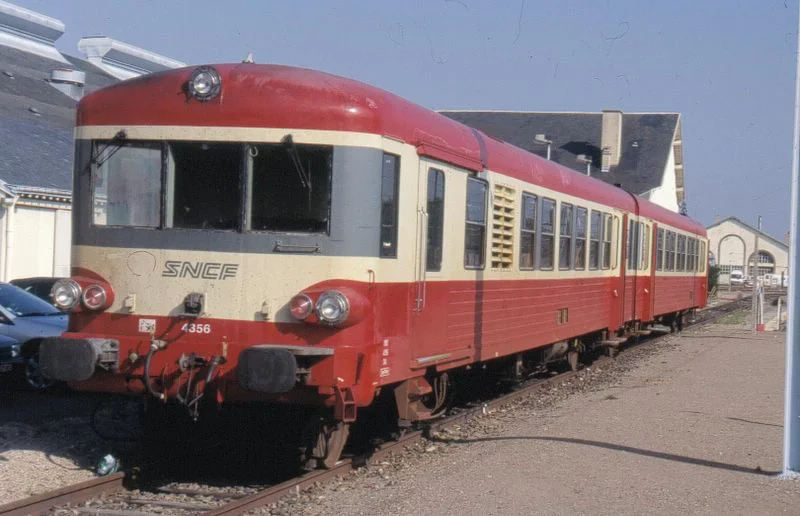
Source: commons.wikimedia.org
Vehicle type: Diesel multiple unit - DMU
Registration country: France
Railway companies: SNCF - Société Nationale des Chemins de Fer français
1963
A total of 151 units, numbered X 4301 to X 4451, were built by ANF between 1963 and 1970. Each unit consisted of a powered railcar coupled to a trailer, forming a permanently associated two-car set. The X 4300 could operate in multiple with up to three EAD sets, including later members of the family such as the X 4500, X 4630, X 4750 and X 4900. The success of the X 4300 therefore established the basic concept for several subsequent generations of SNCF diesel multiple units.
The powered vehicle was equipped with a six-cylinder horizontally opposed SSCM-Poyaud C 6150 SR T diesel engine, installed beneath the floor. It developed 330 kW at 1,800 rpm, with a continuous output of approximately 295 kW, and drove the wheels through an eight-speed mechanical transmission. Maximum speed was 120 km/h. The relatively modest power available to the two-car formation made the X 4300 better suited to routes with comparatively gentle gradients, while engine failures were also a recurring problem during their career.
In their original configuration, the sets measured approximately 42,48 m in length and weighed around 57 tonnes. Depending on the interior arrangement, they provided 133 or 141 seats. When introduced, they carried the characteristic SNCF railcar red-and-cream livery of the period. Second-class accommodation originally consisted largely of bench seating arranged five passengers abreast.
The X 4300 quickly spread across the French network and became characteristic of secondary and regional passenger services. They could be found on routes radiating from cities including Nantes, Tours, Lyon, Dijon, Strasbourg, Metz, Amiens and Paris, as well as on numerous rural and cross-country lines. Their long careers saw them allocated to depots including Lyon-Vaise, Nice-Saint-Roch, Strasbourg, Tours-Saint-Pierre, Évreux, Longueau, Metz-lès-Sablons, Montargis, Nantes, Nevers and Sotteville-lès-Rouen.
By the 1980s, however, their passenger accommodation compared poorly with newer SNCF equipment, particularly the Corail coaches and TGVs with which regional passengers increasingly made connections. SNCF therefore launched a major modernisation programme. The original cab fronts were replaced by reinforced, more angular structures with inclined windscreens, improving protection for the driver in the event of a collision. The passenger interiors were also rebuilt, with individual seats replacing the original benches and seating changing from five to four seats abreast, significantly improving comfort.
The modernisation also introduced new regional liveries. While SNCF financed the technical work—including modifications to the driving cabs, engines, transmissions and running gear—regional authorities could finance the passenger accommodation and exterior treatment. Different regional colour schemes consequently appeared, including Isabelle blue, parrot green, vermilion red and lithos yellow. The rebuilding increased the overall length to approximately 43.48 m and weight to around 58.6 tonnes. The additional weight further reduced the already modest acceleration of the X 4300. (Wikipedia)
During the 2000s, major overhauls progressively ceased as modern regional units such as the X 72500 and X 73500 replaced the ageing Caravelles. Only six X 4300 remained in regular service by 2008, all based at Tours-Saint-Pierre, and regular commercial operation of the series ended in 2009. X 4391 survived longer in a special role as an ETCS test vehicle, while several other examples were preserved by tourist railways. A number of unmodernised X 4300s were also sold abroad, notably to Romania, where examples continued operating in their original form.
With more than four decades of service, the X 4300 became one of the characteristic French regional railcars of the second half of the twentieth century. Their straightforward two-car configuration and extensive geographical distribution made the “Caravelles” an important part of SNCF’s transition from older railcars and locomotive-hauled local trains towards the modern diesel multiple-unit concept.
Sources: https://fr.wikipedia.org/wiki/X_4300
Do you have additional informations regarding this vehicle?
Help us writing the history of X 4300 "Caravelles"! Your knowledge is precious for us and the entire community, do not hesitate to share your facts, photos or videos:
Latest update on the 20th of August 2026 at 14:25
Contributor(s): Tudor C.
Advertising:
X 4300 "Caravelles" - Associated miniature models:
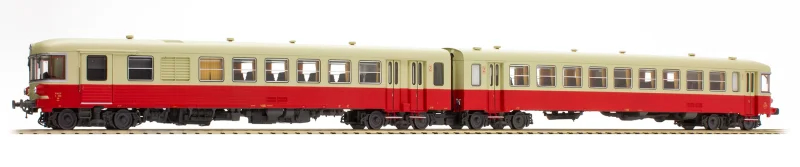
SNCF - X 4300 "Caravelles" diesel multiple units
Recommended retail price: from 409,90 €
Advertising:

The identity card, photos and videos for thousands of railway vehicles all around Europe!
