
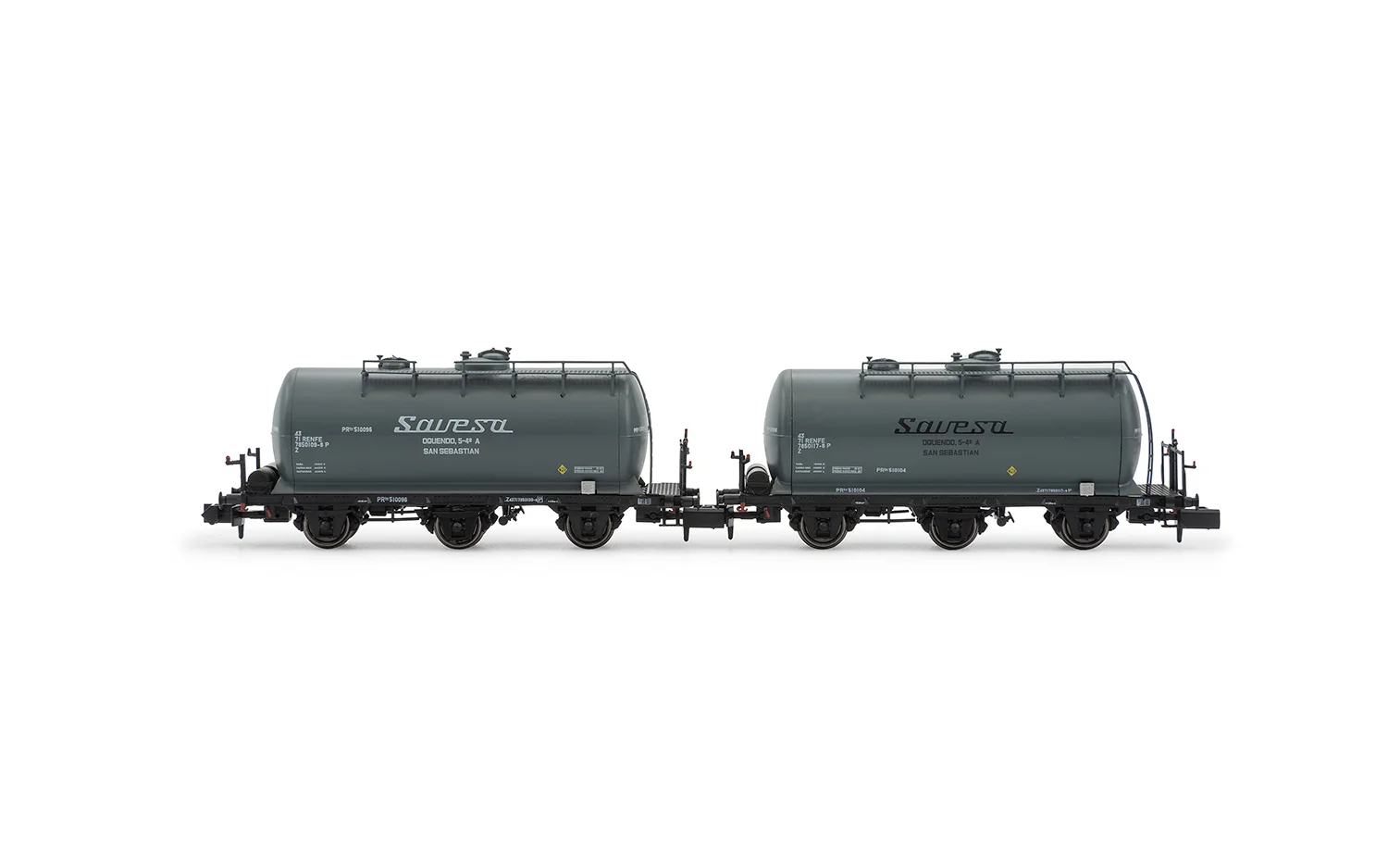
RENFE, set de dos vagones cisterna PR de tres ejes

Scale:
Markings:
Add
About the model
These private wagons operated on the national railway network
alongside company-owned rolling stock, being run by firms such as
Koype or Transfesa, either for their own freight or for third-party
transport. RENFE’s rolling stock was divided into three main
categories: commercial wagons (owned by RENFE), private wagons or
privately-owned stock (where the owner could transport their own
goods—such as Koype, Transoil, Elosua, Borges, Saltra, or Savesa—or
alternatively, offer transport services to other companies,
competing directly with RENFE), and internal fleet wagons (used
exclusively for the railway company’s own logistics). Specifically,
regarding three-axle tank wagons, innovation came in the 1950s from
the factory Herederos de Ramón Múgica, pioneering their design.
These wagons increased carrying capacity while staying within axle
load limits, making them particularly suitable for secondary lines
and industrial sidings. Following their success, many private
companies—including Koipe (manufactured by Electrotren in H0 scale
and by Arnold in N scale), Transfesa, Elosua (manufactured by
Electrotren in H0 scale and by Arnold in N scale), and Borges
(manufactured by Electrotren in H0 scale and by Arnold in N
scale)—placed additional orders, cementing this design within
Spain’s railway freight fleet. The last wagons of this type were
delivered to Borges in 1967. Details of models HN6672, HN6673, and
HN6674: • Central axle with lateral displacement (minimum radius:
192 mm) • Short coupling mechanism according to NEM 352 on both
ends • Coupling pocket according to NEM 355 • Vacuum brake tanks on
the end wall without platform • Distance between buffers: 132 mm
(66 mm per wagon) • Multiple details made of precision photo-etched
metal
...
Catalogs / brochures
Available article numbers:
Arnold HN6672
Technical specifications:

2-rail (direct current - DC)

Coupler with close coupling cinematic

Length over buffers
132 mm
Advertising:

The identity card, photos and videos for thousands of railway vehicles all around Europe!
Copyright © 2026 T&H Services - All rights reserved
Powered by
