
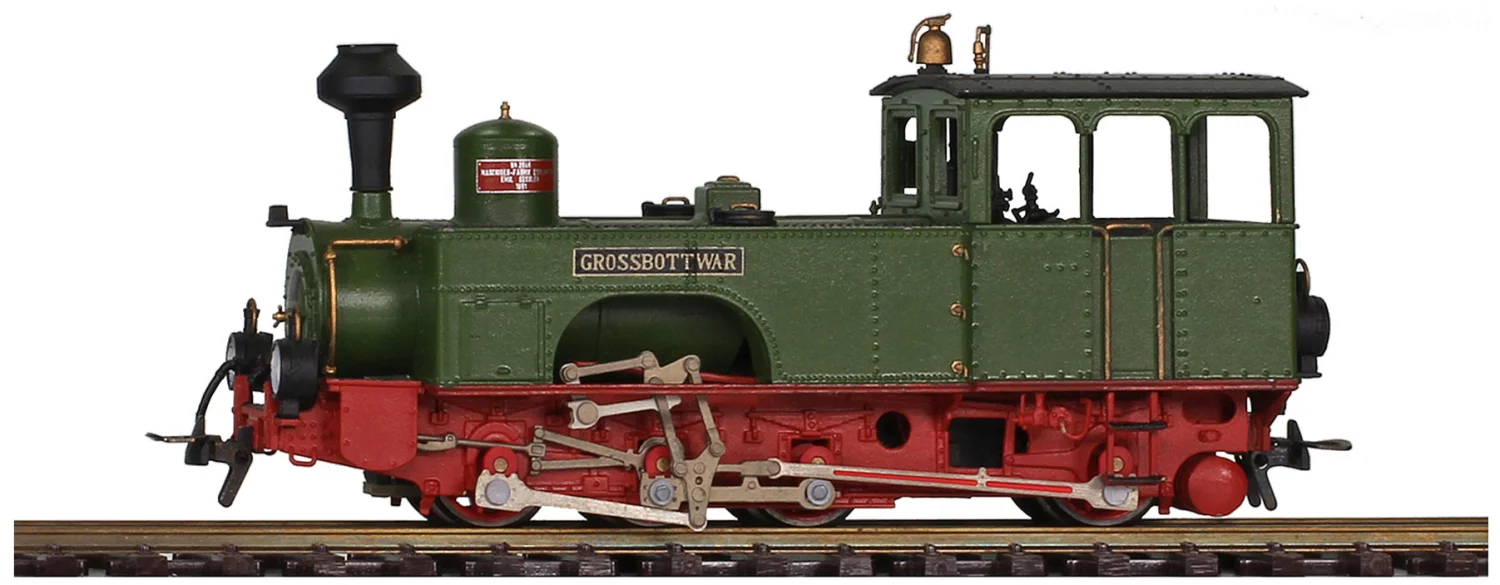
Dampflok Tss 4

Scale:
Markings:
12; 99 621
About the model
Metal Collection
After a long time, the Württemberg Klose locomotive Tss 4 returns to the Bemo range. We are pleased to offer both a kit and ready-made models of this unique machine in eras I and II.
For the country railway version, we have decided to realize locomotive 12 "Oberstenfeld" in two attractive color variants: a classic green livery and a green-gray variant. The latter is color-wise oriented towards the standard-gauge T3 979 "Eschenau," which is exhibited at the Technoseum Mannheim. During the restoration of this locomotive, several layers of paint were recently removed and analyzed in detail, providing valuable insights into the original coloring.
In 1894, three machines of the Tss 4 class left the workshops of the Esslingen machine factory heading towards Bottwartal. The four-coupled locomotives were named after the most significant municipalities of Bottwartal and were to be the first narrow-gauge locomotives with a gauge of 750mm on Württemberg soil. Technically, the machines corresponded to the design of Ts 4, which had already been in use since 1891 on the meter-gauge narrow-gauge line Nagold - Altensteig. The three locomotives, whose replicas are being reissued after a long pause, remained stationed in Beilstein until their retirement in the 1920s. The Tss 4 was particularly characterized by the drive system designed by the Württemberg chief construction officer Adolph Klose (1844-1923). The impetus for the design of the drive system was the difficult track conditions in the Balkans.
Württemberg, due to its topographical location, was also suitable for the use of Klose machines on both standard-gauge and narrow-gauge lines. The chassis design allowed for the radial adjustment of the leading and the last axle. Consequently, the coupling rods had to be variably designed with the help of lever parallelograms to accommodate the changing lengths during curve travel. However, in daily maintenance, the drive system proved to be very sensitive to disturbances and increased maintenance costs. The reverse driving characteristics were also not optimal, necessitating the installation of turntables at the endpoints of the Bottwartalbahn. For these reasons, other railway administrations refrained from purchasing, and the Klose class machines did not achieve significant success. Consequently, Württemberg also opted for the Mallett design when procuring new narrow-gauge locomotives with the Tssd.
...
After a long time, the Württemberg Klose locomotive Tss 4 returns to the Bemo range. We are pleased to offer both a kit and ready-made models of this unique machine in eras I and II.
For the country railway version, we have decided to realize locomotive 12 "Oberstenfeld" in two attractive color variants: a classic green livery and a green-gray variant. The latter is color-wise oriented towards the standard-gauge T3 979 "Eschenau," which is exhibited at the Technoseum Mannheim. During the restoration of this locomotive, several layers of paint were recently removed and analyzed in detail, providing valuable insights into the original coloring.
In 1894, three machines of the Tss 4 class left the workshops of the Esslingen machine factory heading towards Bottwartal. The four-coupled locomotives were named after the most significant municipalities of Bottwartal and were to be the first narrow-gauge locomotives with a gauge of 750mm on Württemberg soil. Technically, the machines corresponded to the design of Ts 4, which had already been in use since 1891 on the meter-gauge narrow-gauge line Nagold - Altensteig. The three locomotives, whose replicas are being reissued after a long pause, remained stationed in Beilstein until their retirement in the 1920s. The Tss 4 was particularly characterized by the drive system designed by the Württemberg chief construction officer Adolph Klose (1844-1923). The impetus for the design of the drive system was the difficult track conditions in the Balkans.
Württemberg, due to its topographical location, was also suitable for the use of Klose machines on both standard-gauge and narrow-gauge lines. The chassis design allowed for the radial adjustment of the leading and the last axle. Consequently, the coupling rods had to be variably designed with the help of lever parallelograms to accommodate the changing lengths during curve travel. However, in daily maintenance, the drive system proved to be very sensitive to disturbances and increased maintenance costs. The reverse driving characteristics were also not optimal, necessitating the installation of turntables at the endpoints of the Bottwartalbahn. For these reasons, other railway administrations refrained from purchasing, and the Klose class machines did not achieve significant success. Consequently, Württemberg also opted for the Mallett design when procuring new narrow-gauge locomotives with the Tssd.
Catalogs / brochures
Available article numbers:
BEMO 1014800
Technical specifications:

2-rail (direct current - DC)

Length over buffers
93.3 mm

Minimum drivable radius
330 mm
Advertising:

The identity card, photos and videos for thousands of railway vehicles all around Europe!
Copyright © 2026 T&H Services - All rights reserved
Powered by
