
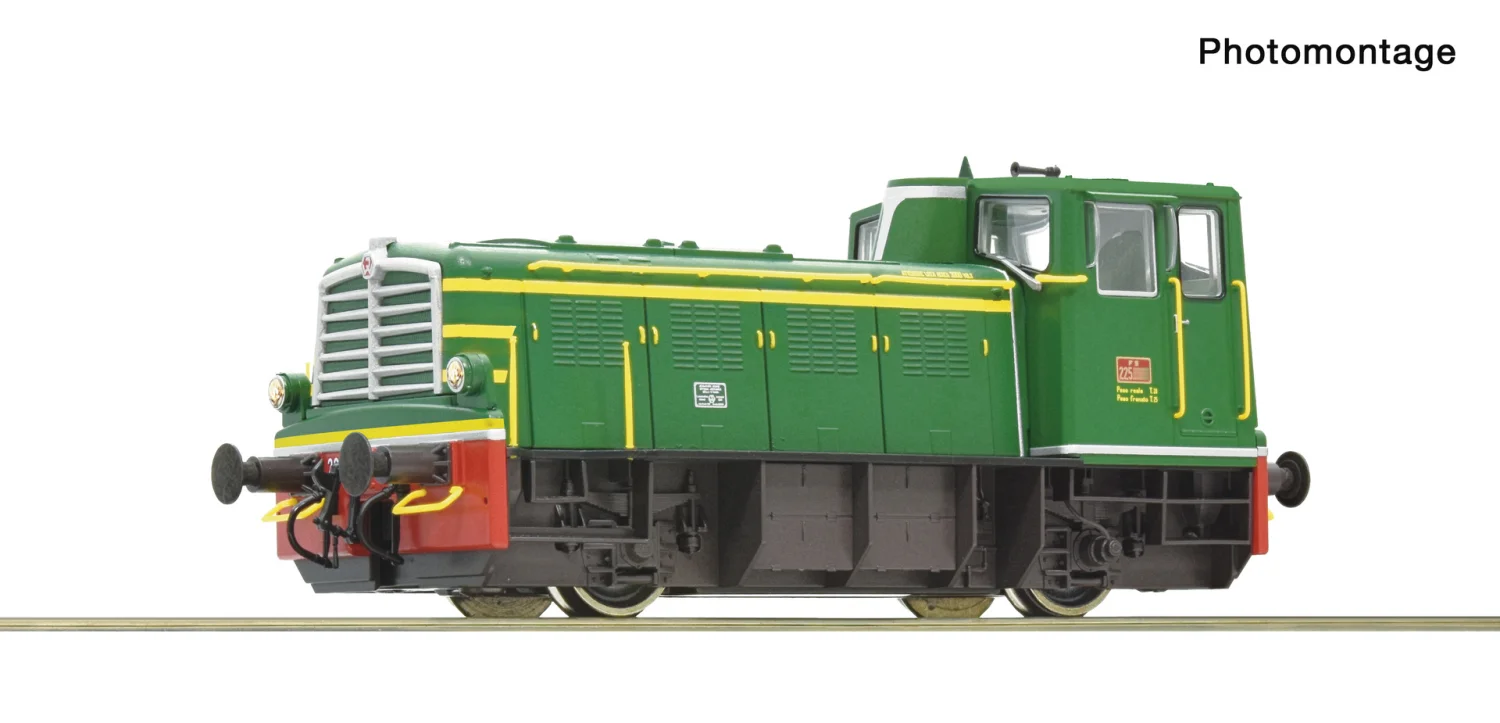
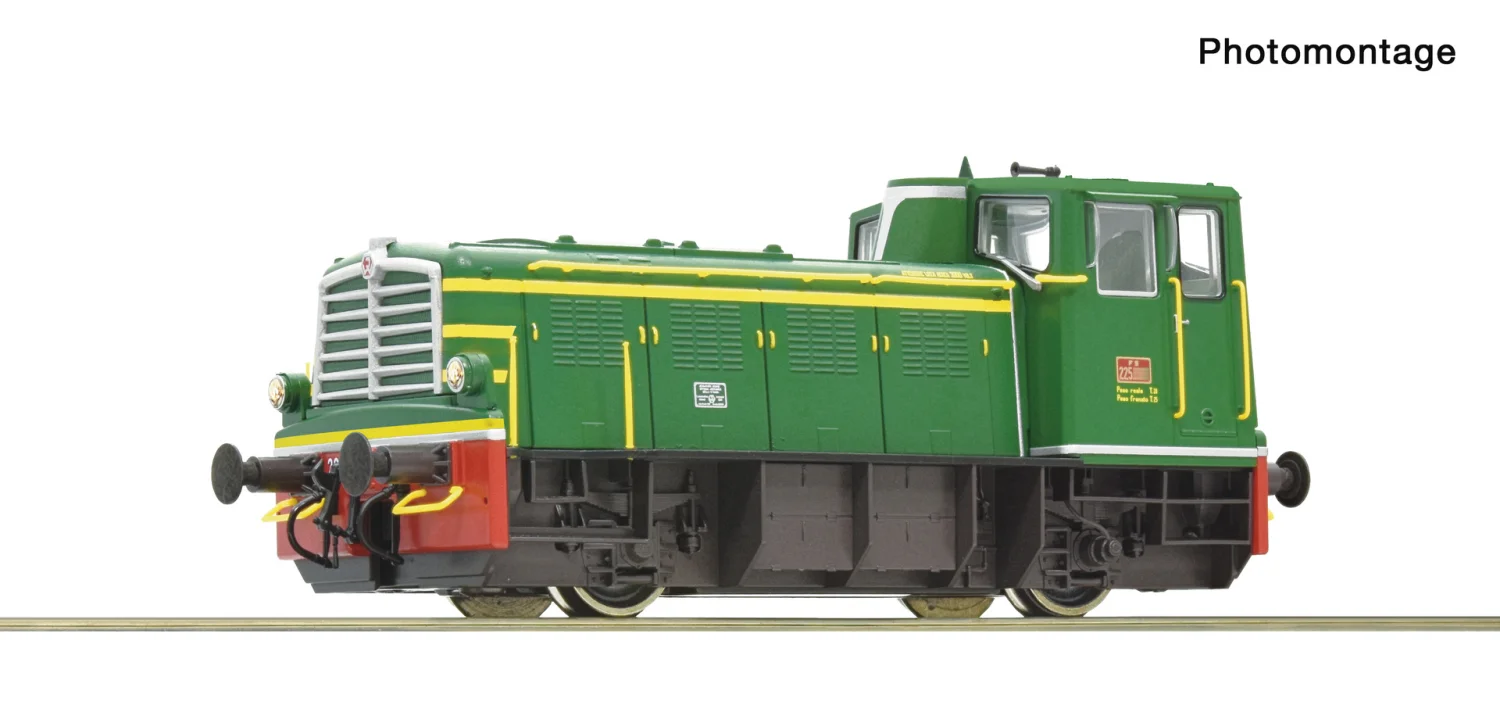
Diesel locomotive D.225.6014, FS

Scale:
Markings:
Add
About the model
Diesel locomotive D.225.6014 of the Italian State Railways.
■ Equipped with a digital shunting coupler for more play fun
■ Motor bonnet and gearbox block made of die-cast zinc, providing greater weight and high tractive force
■ Finely detailed design with many plug-in parts and free-standing grab rails
■ True-to-prototype lighting and sound functions, switchable via the onboard decoder
■ Unobstructed view through the true-to-original driver's cab
■ Buffer capacitor for uninterruptible power supply
The Group 225 shunting locomotives were standard-gauge diesel locomotives that were used in shunting operations across the entire Italian network from 1955 onwards. They were built in four subtypes with different characteristics: D.225.5000, D.225.2100 and D.225.7000 with rod drive, manufactured by various Italian manufacturers, and D.225.6000 with cardan drive, a licensed replica of the Class 2062 built by Jenbacher Werke for the ÖBB. In 1958, Jenbacher Werke delivered two prototypes fitted with different engines, which were added to the locomotive fleet as 225.6098 (corresponding to ÖBB 2060) and 225.6099. A total of 20 production locomotives were manufactured under licence in 1960–61 by Officina Meccanica della Stranga in Padua and Jenbach Diesel Soc.r.l. in Bolzano, and were registered with the running numbers 225.6001 to 6020. A two-stroke diesel engine with hydraulic power transmission provided the locomotive's propulsion. The maximum speed was 30 km/h in shunting gear and 50 km/h in line gear.
The model can only be operated to a limited extent with analogue control units.
...
■ Equipped with a digital shunting coupler for more play fun
■ Motor bonnet and gearbox block made of die-cast zinc, providing greater weight and high tractive force
■ Finely detailed design with many plug-in parts and free-standing grab rails
■ True-to-prototype lighting and sound functions, switchable via the onboard decoder
■ Unobstructed view through the true-to-original driver's cab
■ Buffer capacitor for uninterruptible power supply
The Group 225 shunting locomotives were standard-gauge diesel locomotives that were used in shunting operations across the entire Italian network from 1955 onwards. They were built in four subtypes with different characteristics: D.225.5000, D.225.2100 and D.225.7000 with rod drive, manufactured by various Italian manufacturers, and D.225.6000 with cardan drive, a licensed replica of the Class 2062 built by Jenbacher Werke for the ÖBB. In 1958, Jenbacher Werke delivered two prototypes fitted with different engines, which were added to the locomotive fleet as 225.6098 (corresponding to ÖBB 2060) and 225.6099. A total of 20 production locomotives were manufactured under licence in 1960–61 by Officina Meccanica della Stranga in Padua and Jenbach Diesel Soc.r.l. in Bolzano, and were registered with the running numbers 225.6001 to 6020. A two-stroke diesel engine with hydraulic power transmission provided the locomotive's propulsion. The maximum speed was 30 km/h in shunting gear and 50 km/h in line gear.
The model can only be operated to a limited extent with analogue control units.
Catalogs / brochures
Available article numbers:
Roco 7310161
Technical specifications:

2-rail (direct current - DC)

DCC (Digital)

Integrated sound

Energy storage: buffer capacitor for an uninterruptible power supply

Number of axles with traction tyres
1

Number of driven axles
2

LED headlights

Double headlights alternating with the direction of travel

Interior LED lighting

Length over buffers
221 mm

Minimum drivable radius
358 mm
Show more
Advertising:

The identity card, photos and videos for thousands of railway vehicles all around Europe!
Copyright © 2026 T&H Services - All rights reserved
Powered by
