
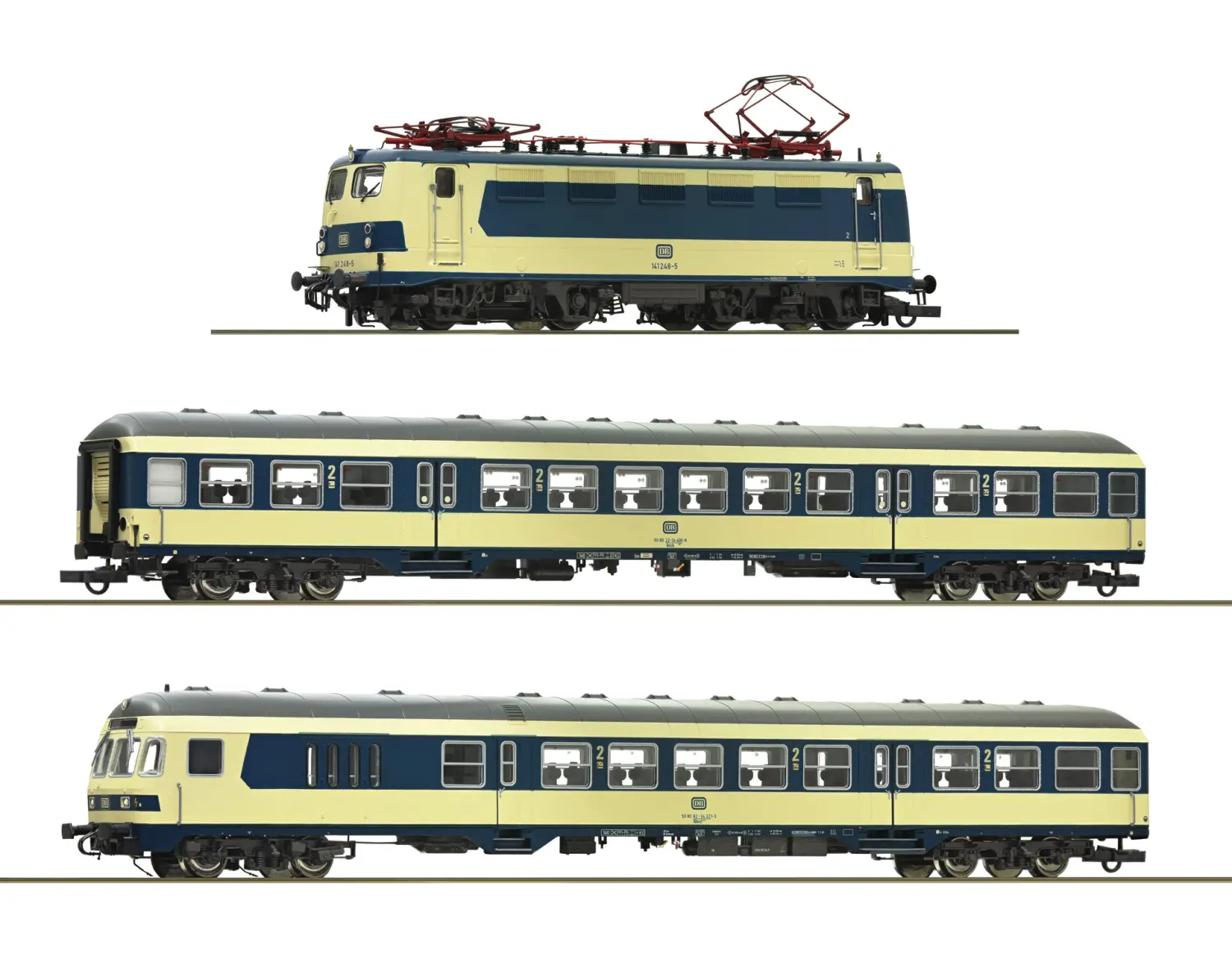
DB - 3 piece set: The Karlsruhe train

Scale:
Markings:
Add
About the model
Train set with an electric locomotive class 141 and two commuter
coaches of the Deutsche Bundesbahn.
The train set contains an electric locomotive 141 248-5, a 2nd class commuter coach (replacement coach) type Bnrzb 725 and a commuter coach with control cab type BDnrzf 740 in ocean blue/beige livery.
■ Locomotive and coaches in unique test livery
■ Version of the 2nd class coach as a replacement coach
■ Matching coaches: item no. 64175
■ The headlights can be partially or entirely switched off with a DIP switch (only locomotive)
■ The driver's cab illumination can be retrofitted and is switchable in digital mode (only locomotive)
■ Control cab coach with PluX22 interface
Attention: When operating on digital systems, the control coach must be equipped with an appropriate decoder. Please refer to the operating instructions!
In the mid-1970s, the Ausbesserungswerk Karlsruhe developed three prototype carriages for a push-pull train and urban railway operations in the Ruhr area. Why? There were many complaints from passengers that there was no WC in the ET 420 railcars on the long routes in the area of the Ruhrgebiet. So the Deutsche Bundesbahn relied on the many "Silberlinge" available at the time. The test coaches were given a new, more clearly arranged interior. Instead of the hinged folding doors, the vehicles were fitted with pivot-and-slide doors with electromagnetic door locking. Instead of the luggage compartment, seats were also installed in the driver's cab coach. The coaches were painted in ocean blue/beige colours. Compared to other trains at that time, the window band was ocean blue and the area under the windows beige. The 141 248, from the Hagen-Eckesey depot, was painted asymmetrically to give it a uniform appearance. Two additional standard "Silberlinge" were repainted to be used as replacement coaches. In the end, the train could not impress with its performance in the S-Bahn service, also because of the comparatively moderate acceleration capacity of the locomotive. The coaches were then used in the regular local traffic, which was not possible without restrictions; however, the coaches' accesses were only permitted for elevated platforms.
...
The train set contains an electric locomotive 141 248-5, a 2nd class commuter coach (replacement coach) type Bnrzb 725 and a commuter coach with control cab type BDnrzf 740 in ocean blue/beige livery.
■ Locomotive and coaches in unique test livery
■ Version of the 2nd class coach as a replacement coach
■ Matching coaches: item no. 64175
■ The headlights can be partially or entirely switched off with a DIP switch (only locomotive)
■ The driver's cab illumination can be retrofitted and is switchable in digital mode (only locomotive)
■ Control cab coach with PluX22 interface
Attention: When operating on digital systems, the control coach must be equipped with an appropriate decoder. Please refer to the operating instructions!
In the mid-1970s, the Ausbesserungswerk Karlsruhe developed three prototype carriages for a push-pull train and urban railway operations in the Ruhr area. Why? There were many complaints from passengers that there was no WC in the ET 420 railcars on the long routes in the area of the Ruhrgebiet. So the Deutsche Bundesbahn relied on the many "Silberlinge" available at the time. The test coaches were given a new, more clearly arranged interior. Instead of the hinged folding doors, the vehicles were fitted with pivot-and-slide doors with electromagnetic door locking. Instead of the luggage compartment, seats were also installed in the driver's cab coach. The coaches were painted in ocean blue/beige colours. Compared to other trains at that time, the window band was ocean blue and the area under the windows beige. The 141 248, from the Hagen-Eckesey depot, was painted asymmetrically to give it a uniform appearance. Two additional standard "Silberlinge" were repainted to be used as replacement coaches. In the end, the train could not impress with its performance in the S-Bahn service, also because of the comparatively moderate acceleration capacity of the locomotive. The coaches were then used in the regular local traffic, which was not possible without restrictions; however, the coaches' accesses were only permitted for elevated platforms.
Catalogs / brochures
Available article numbers:
Roco 61483
Technical specifications:

2-rail (direct current - DC)

Flywheel drive

5-pole motor

PluX22 interface (NEM 658)

Number of axles with traction tyres
1

Number of driven axles
4

Coupler standard pocket (NEM 362)

Coupler with close coupling cinematic
LED headlights

Triple headlights and two taillights alternating with the direction of travel

Interior LED lighting

With interior fittings

Length over buffers
786 mm

Minimum drivable radius
358 mm
Show more
Roco 61484
Technical specifications:
2-rail (direct current - DC)

DCC (Digital)
Flywheel drive
5-pole motor
PluX22 interface (NEM 658)

Integrated sound
Number of axles with traction tyres
1
Number of driven axles
4
Coupler standard pocket (NEM 362)
Coupler with close coupling cinematic
LED headlights
Triple headlights and two taillights alternating with the direction of travel
Interior LED lighting
With interior fittings
Length over buffers
786 mm
Minimum drivable radius
358 mm
Show more
Roco 61485
Technical specifications:
3-rail (alternating current - AC)
DCC (Digital)
Flywheel drive
5-pole motor
PluX22 interface (NEM 658)
Integrated sound
Number of axles with traction tyres
2
Number of driven axles
2
Coupler standard pocket (NEM 362)
Coupler with close coupling cinematic
LED headlights
Triple headlights and two taillights alternating with the direction of travel
Interior LED lighting
With interior fittings
Length over buffers
786 mm
Minimum drivable radius
358 mm
Show more
Advertising:

The identity card, photos and videos for thousands of railway vehicles all around Europe!
Copyright © 2026 T&H Services - All rights reserved
Powered by
