

Source: Markus Tellerup - jarnvag.net
80 t*
*300 & 400 series
82 t*
*700 & 800 series
4000 kW*
*400 series
*new
140 km/h*
*600, 700 & 800 series
*300, 400 & 800 series
*300, 400 & 700 series
wheel rims lubrication*
*400, 500, 600 & 700 series
Si-diode*
*000, 100, 200, 300, 400 & 500 series
Thyristor*
*600, 700 & 800 series
Intro
Built initially by the international 50 Hz Traction Union group (consisting of the Swedish ASEA, the Austrian ELIN-Union and SGP and the Swiss Sécheron) and subsequently under licence by the Yugoslav railway industry led by Rade Končar in Zagreb, the 441 family remained in production for around two decades. Numerous variants were developed during this period, incorporating increasingly large amounts of Yugoslav-built equipment and later technical improvements.
1960s
Yugoslavia chooses the 25 kV 50 Hz system
This created a requirement for a new generation of electric locomotives capable of operating both passenger and freight trains over the varied geography of Yugoslavia, including demanding mountain routes.
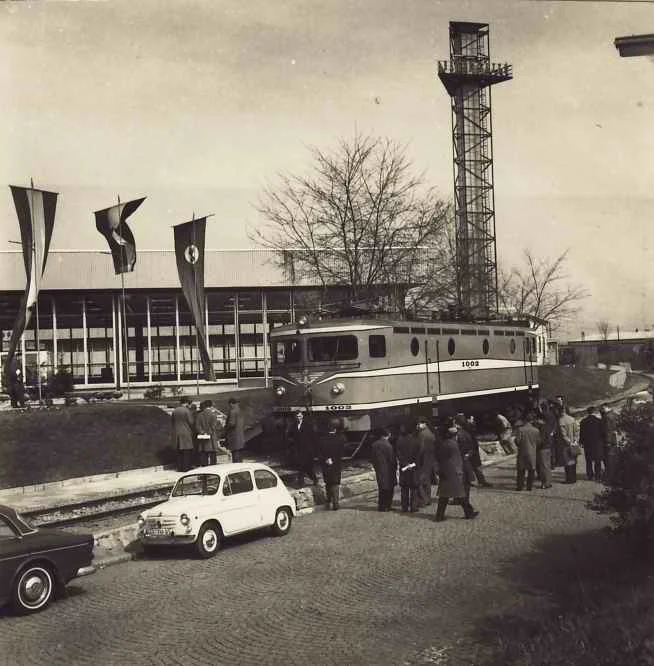 During the early 1960s, the 50 Hz Traction Union
presented a Swedish SJ Rb locomotive in
Belgrade. The design attracted the attention of JŽ and became the technological basis
from which the future Yugoslav locomotive would be developed.
During the early 1960s, the 50 Hz Traction Union
presented a Swedish SJ Rb locomotive in
Belgrade. The design attracted the attention of JŽ and became the technological basis
from which the future Yugoslav locomotive would be developed.The resulting locomotive retained important characteristics of the Swedish Rb concept. The electrical equipment was supplied through the members of the 50 Hz Traction Union, while SGP was responsible for the mechanical construction and assembly of the first locomotives. The body design also showed a close relationship with ASEA’s subsequent Swedish Rc family.
The new Yugoslav locomotive received the series designation 441.
1966
Contracts, foreign production and transfer of technology
During the second half of the 1960s, agreements were concluded between JŽ, the 50 Hz Traction Union and the Zagreb electrical engineering company Rade Končar. They covered the delivery of locomotives and components, licensing arrangements and the progressive participation of Yugoslav companies in production. A further agreement with domestic industry provided for the manufacture of locomotives in Yugoslavia.
Several Yugoslav factories consequently became involved in the programme. Rade Končar had the leading role in the electrical equipment, while other participating companies included Energoinvest, Đuro Đaković, MIN, Minel and Janko Gredelj.
The first locomotives were assembled by SGP at Graz in Austria, with deliveries beginning in the late 1960s. An important milestone was reached when the first domestically produced locomotive was completed. JŽ 441-040, the first 441 built in Yugoslavia, was delivered to JŽ on 30 January 1970.
1970s
The 441 becomes Yugoslavia’s standard electric locomotive
The locomotives proved sufficiently successful for JŽ to continue ordering them and for domestic production to expand during the 1970s. The original ASEA-derived design was progressively adapted by the Yugoslav manufacturers.
The early locomotives used silicon-diode rectifier control. After the original licence arrangements came to an end in 1973, Yugoslav engineers increasingly modified components and systems themselves, with the objective of improving reliability and increasing the proportion of domestically manufactured equipment. By 1978, around 200 diode-equipped locomotives had been delivered, with an increasingly high Yugoslav content. This progressive localisation explains why locomotives belonging to the same overall 441 family can show numerous technical and external differences.
The Romanian connection
The JŽ 441 programme also became connected with railway industrial cooperation between Yugoslavia and Romania.
During the 1970s an agreement provided for the construction in Romania of 130 four-axle locomotives derived from the 441 design, known there initially as 040-EC and subsequently incorporated into the CFR Class 43 / Class 44 family.
The industrial exchange operated in both directions. Romania supplied components and locomotive structures connected with the four-axle programme, while Yugoslavia acquired 100 six-axle Electroputere locomotives of the 060-EA family. These Romanian-built six-axle machines entered JŽ service as the series 461.
Although closely related technically, the Romanian 040-EC locomotives were not exact copies of the Yugoslav machines. Among the visible differences, the cab arrangement was effectively mirrored: on the Yugoslav version the cab entrance was on the right and the driver’s position on the left, whereas the Romanian version had the opposite arrangement. Differences could also be found in headlights, battery boxes, buffer equipment and other details.
1980s
Improved and faster versions
Among the principal differences were the presence or absence of electric braking, multiple-unit control and wheel-flange lubrication, as well as changes to the electrical control equipment. Later locomotives introduced thyristor technology, while some passenger-oriented variants were geared for a maximum speed of 140 km/h instead of the original 120 km/h. The 441-600 and 441-700 groups were among the versions designed for 140 km/h operation, allowing the basic locomotive family to perform faster passenger duties while retaining the general mechanical concept of the earlier machines.
Production continued until the second half of the 1980s. Sources differ over the precise total depending on which industrial or special-purpose locomotives are included. A commonly quoted figure for the JŽ fleet is 285.
Their combination of relatively high power, four-axle construction and universal gearing allowed the 441s to work almost every category of electrically hauled train. They became a familiar sight on the major 25 kV routes linking Zagreb, Belgrade, Sarajevo, Skopje and other major centres of the Yugoslav network, hauling everything from international passenger trains to heavy freight services.
1991
The breakup of Yugoslavia
The locomotives subsequently appeared under a number of designations:
in Croatia, the former 441s became HŽ series 1141;
in Serbia, they initially retained the 441 designation, with rebuilt locomotives later forming the series 444;
in Bosnia and Herzegovina, locomotives continued operating as HŽHB / ŽBiH / ŽFBiH 441 and ŽRS 441;
in North Macedonia, they operated as MŽ 441, alongside related rebuilt variants.
Do you have additional informations regarding this vehicle?
Help us writing the history of Class 441! Your knowledge is precious for us and the entire community, do not hesitate to share your facts, photos or videos:
Latest update on the 19th of September 2026 at 16:30
Contributor(s): Tudor C.
Advertising:
Class 441 - Associated miniature models:
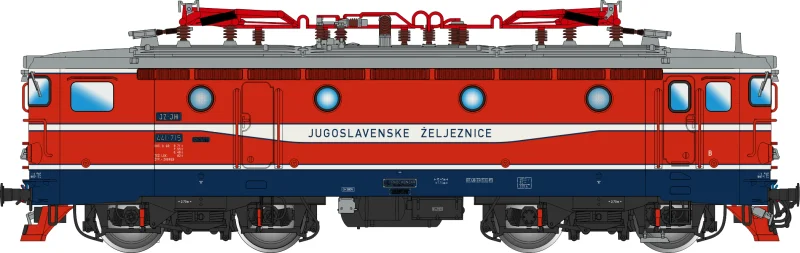
JZ / JŽ - Electric locomotive Class 441
Recommended retail price: from 269,90 €
Advertising:

The identity card, photos and videos for thousands of railway vehicles all around Europe!
