
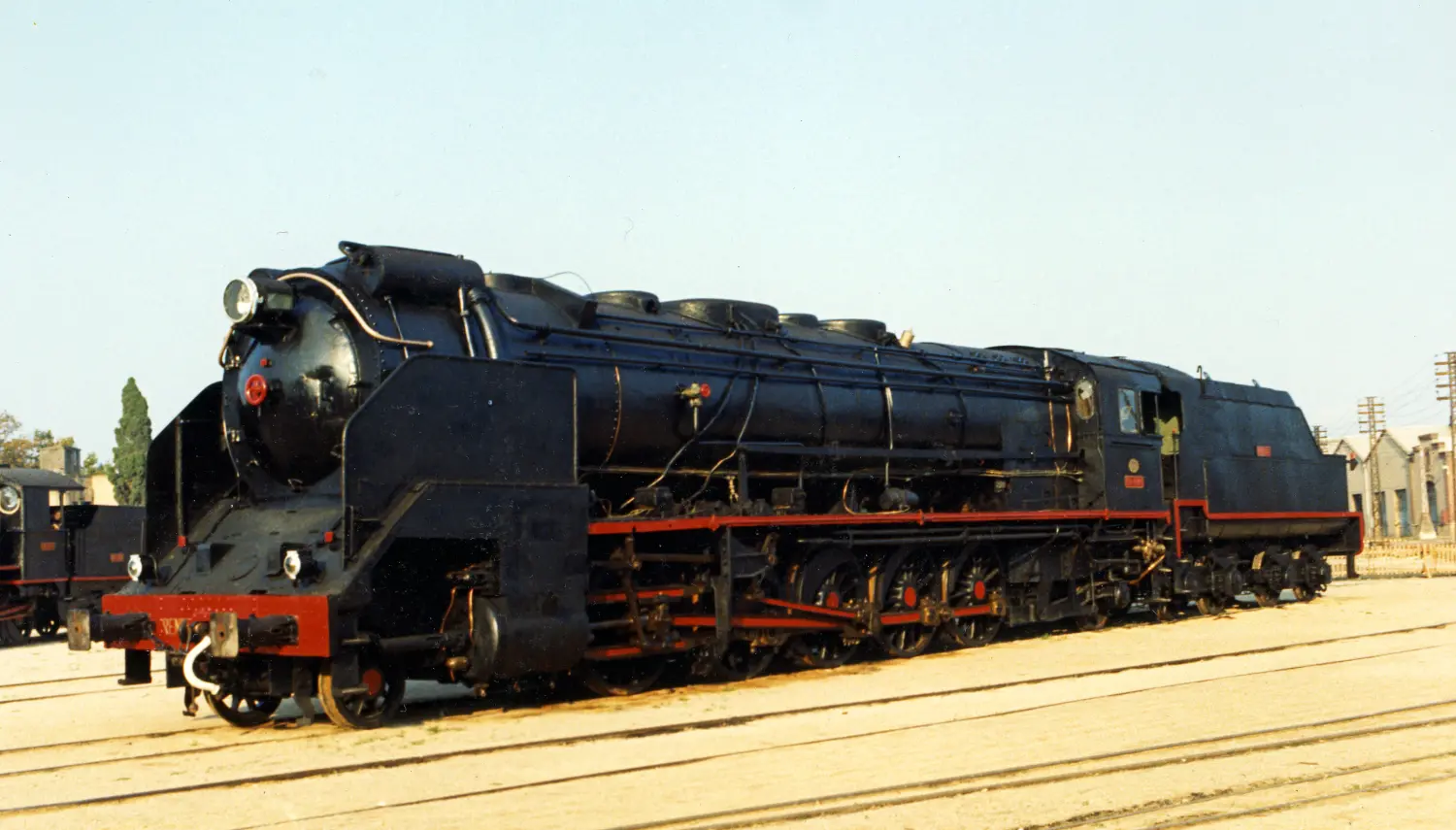
Source: es.wikipedia.org
1930
The RENFE Series 151 (originally the
Norte 5000 Series) is a class of heavy
steam locomotives that represented the pinnacle of Spanish steam
power. Known as the "Santa Fe" type due to their
1-5-1 wheel arrangement, these locomotives were the most powerful
steam engines ever to operate in Spain and among the most
formidable in Western Europe.
The series was born from the needs of the Compañía de los Caminos de Hierro del Norte de España (Norte). By the late 1930s, Norte faced significant challenges transporting heavy coal and freight trains over the steep, mountainous terrain of the Spanish Northwest - specifically the grueling Brañuelas ramp on the León-Ponferrada line, which was the primary gateway to Galicia.
Norte commissioned La Maquinista Terrestre y Marítima (MTM) in Barcelona to design a locomotive capable of hauling 800-ton trains up continuous gradients at a steady speed. Although the order was placed before the creation of RENFE (Spain’s nationalized railway), the locomotives were delivered starting in 1942, shortly after RENFE was formed.
The Series 151 was a masterpiece of Spanish engineering, designed to maximize tractive effort and adhesive weight:
Wheel arrangement: 1-5-1 (Santa Fe), which allowed for five coupled driving axles to handle heavy loads while maintaining stability on curves.
Cylinders: A three-cylinder simple expansion system (one internal, two external).
Power output: Approximately 3'960 CV (3'900 HP), making them the most powerful locomotives in Spain until the arrival of the "Confederación" series.
Tractive effort: 32'359 kg (71'340 lbs), the highest of any Spanish steam locomotive.
Weight: The engine alone weighed approximately 144 tons (203 tons including the tender).
Max speed: 90 km/h, though they typically operated at lower speeds due to the nature of their freight duties.
The 22 units (numbered 3101 - 3122) were initially stationed at the León depot. They became the backbone of heavy coal transport, nicknamed the "Coal Trains of the North". Their massive size and haunting three-cylinder exhaust beat made them iconic among railway workers and enthusiasts alike.
The series was born from the needs of the Compañía de los Caminos de Hierro del Norte de España (Norte). By the late 1930s, Norte faced significant challenges transporting heavy coal and freight trains over the steep, mountainous terrain of the Spanish Northwest - specifically the grueling Brañuelas ramp on the León-Ponferrada line, which was the primary gateway to Galicia.
Norte commissioned La Maquinista Terrestre y Marítima (MTM) in Barcelona to design a locomotive capable of hauling 800-ton trains up continuous gradients at a steady speed. Although the order was placed before the creation of RENFE (Spain’s nationalized railway), the locomotives were delivered starting in 1942, shortly after RENFE was formed.
The Series 151 was a masterpiece of Spanish engineering, designed to maximize tractive effort and adhesive weight:
Wheel arrangement: 1-5-1 (Santa Fe), which allowed for five coupled driving axles to handle heavy loads while maintaining stability on curves.
Cylinders: A three-cylinder simple expansion system (one internal, two external).
Power output: Approximately 3'960 CV (3'900 HP), making them the most powerful locomotives in Spain until the arrival of the "Confederación" series.
Tractive effort: 32'359 kg (71'340 lbs), the highest of any Spanish steam locomotive.
Weight: The engine alone weighed approximately 144 tons (203 tons including the tender).
Max speed: 90 km/h, though they typically operated at lower speeds due to the nature of their freight duties.
The 22 units (numbered 3101 - 3122) were initially stationed at the León depot. They became the backbone of heavy coal transport, nicknamed the "Coal Trains of the North". Their massive size and haunting three-cylinder exhaust beat made them iconic among railway workers and enthusiasts alike.
1950s
In the 1950s and 60s, as RENFE began its modernization program.
Most of the series was converted from coal to fuel-oil (oil-fired)
in the mid-1960s to improve efficiency and ease of operation.
As the León-Ponferrada line was electrified, these units were reassigned to other depots, including Arcos de Jalón and Cerro Negro (Madrid), to work heavy freight on the Madrid - Zaragoza line.
As the León-Ponferrada line was electrified, these units were reassigned to other depots, including Arcos de Jalón and Cerro Negro (Madrid), to work heavy freight on the Madrid - Zaragoza line.
1968
Despite their power, these locomotives were victims of their own
specialized design. Their massive weight was hard on the tracks,
and the three-cylinder mechanism required intensive maintenance. As
electrification and dieselization expanded across Spain in the late
1960s, the need for heavy steam power vanished.
The series was gradually withdrawn between 1968 and 1970. By the early 1970s, the era of the Spanish Santa Fe had officially ended.
Of the 22 units built, only one survives today: locomotive 151F-3101 (the class leader, originally Norte 5001) was saved from the scrap heap. It is currently preserved and on static display at the Railway Museum of Catalonia in Vilanova i la Geltrú. It remains a testament to the "Golden Age" of Spanish steam, dwarfing almost everything else in the museum's collection.
The series was gradually withdrawn between 1968 and 1970. By the early 1970s, the era of the Spanish Santa Fe had officially ended.
Of the 22 units built, only one survives today: locomotive 151F-3101 (the class leader, originally Norte 5001) was saved from the scrap heap. It is currently preserved and on static display at the Railway Museum of Catalonia in Vilanova i la Geltrú. It remains a testament to the "Golden Age" of Spanish steam, dwarfing almost everything else in the museum's collection.
Do you have additional informations regarding this vehicle?
Help us writing the history of Class 151 "Santa Fe"! Your knowledge is precious for us and the entire community, do not hesitate to share your facts, photos or videos:
Latest update on the 11th of January 2026 at 12:02
Contributor(s): Tudor C.
Advertising:

The identity card, photos and videos for thousands of railway vehicles all around Europe!
Copyright © 2026 T&H Services - All rights reserved
Powered by
