
Source: flickr.com
Source: R. Werder - polier.ch
Source: P. Sutter - polier.ch

Source: wikipedia.org
1978
At the time, SBB’s versatile Re 4/4II fleet formed the backbone of Swiss electric traction. Although reliable, these locomotives were too heavy and technologically outdated for future requirements. The slightly more powerful Re 4/4III improved traction performance but sacrificed top speed, and both designs used conventional DC traction systems that were approaching their developmental limits.
To test new power-electronic technologies and lighter mechanical construction, SBB placed an order in 1978 for four prototype locomotives from Swiss industry. The project was entrusted to Schweizerische Lokomotiv- und Maschinenfabrik (SLM) in Winterthur for mechanical design, and Brown, Boveri & Cie (BBC) in Baden and Oerlikon for electrical equipment.
The prototypes were officially classified Re 4/4IV, following Swiss nomenclature for four-axle electric locomotives (Re = Rangierfähig + Elektrisch, 4/4 = four powered axles on four total axles, IV = fourth generation).
1982
The SBB used these tests to experiment with new color schemes, and each prototype was painted differently:
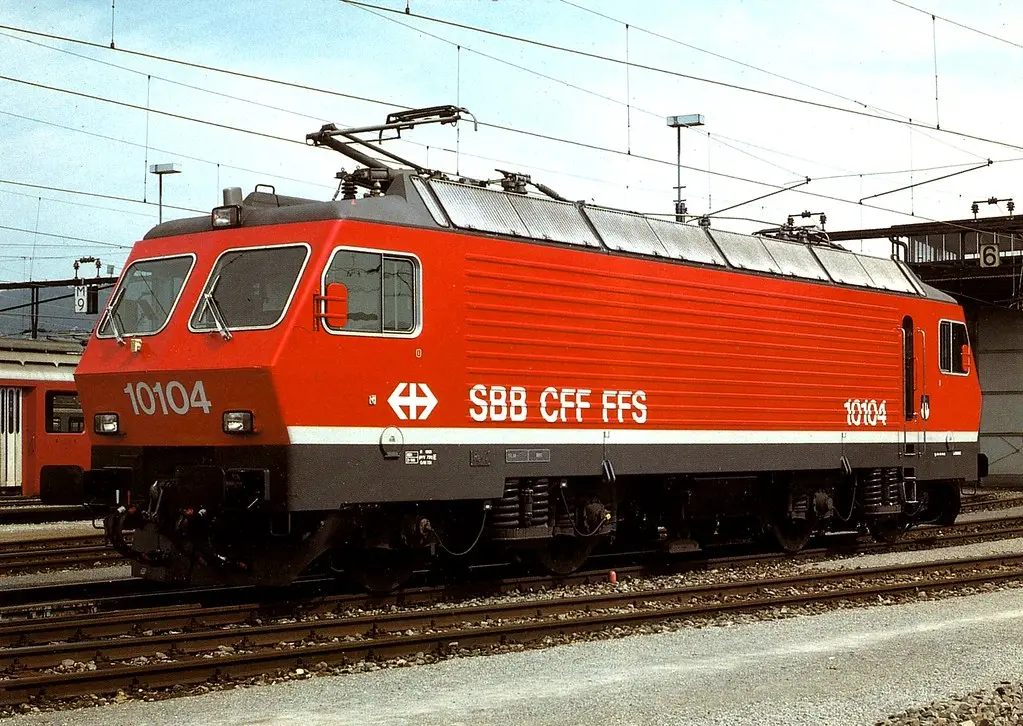
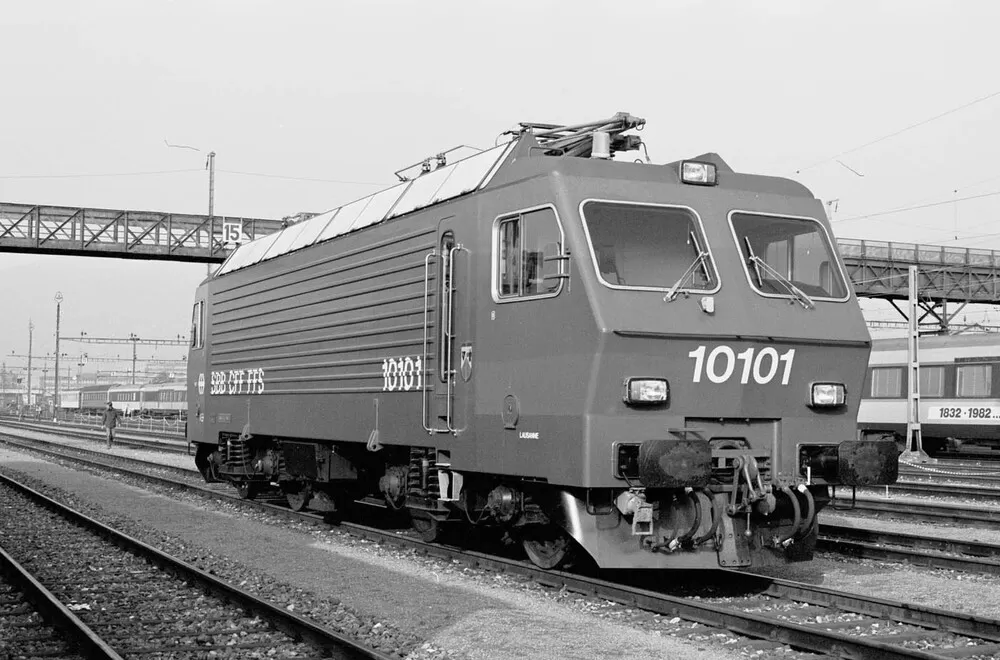
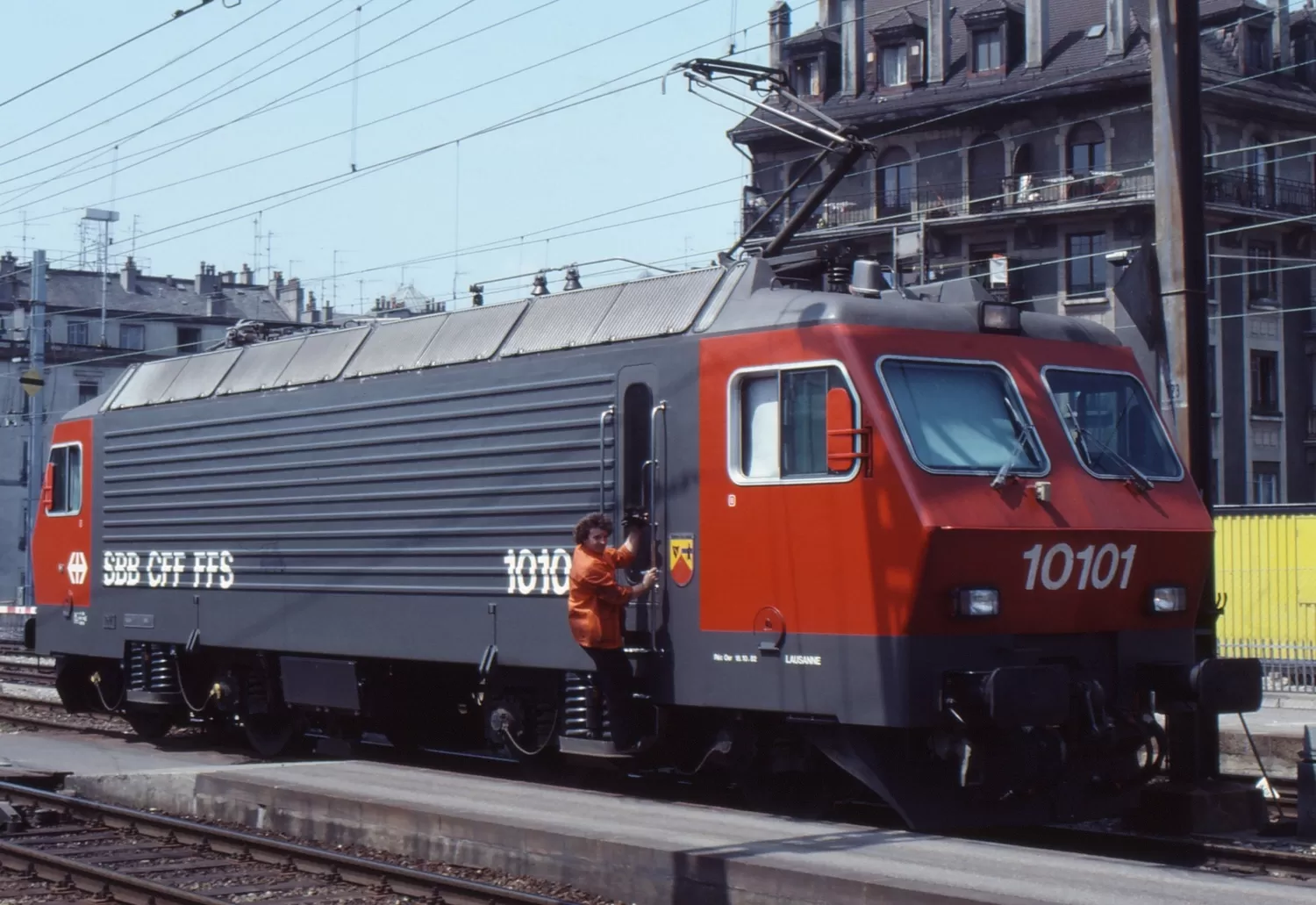
• 10101 – red cab ends with dark gray sides;
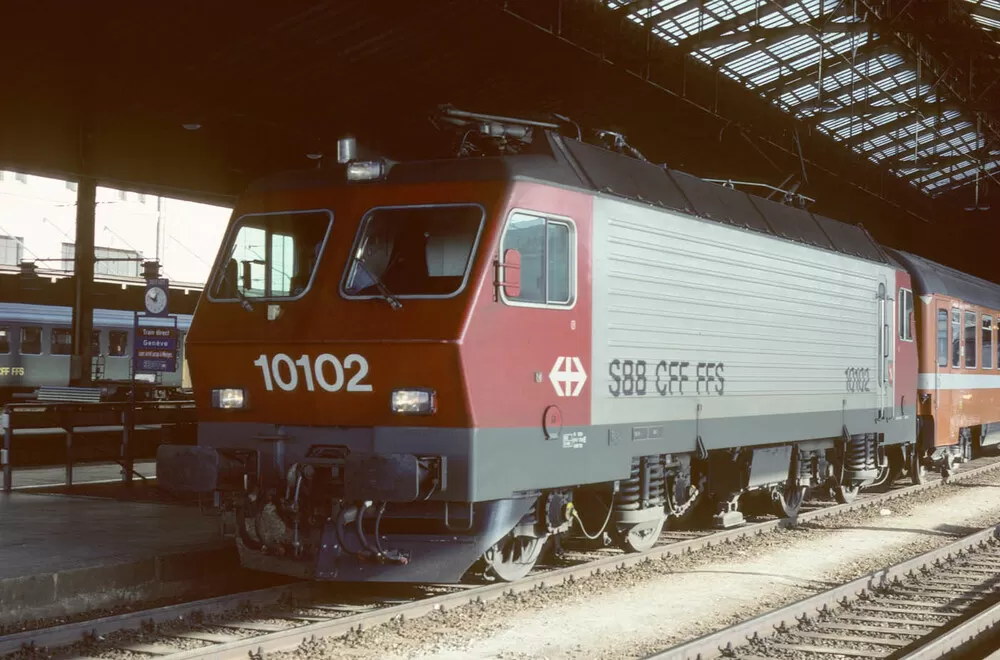
• 10102 – red cab ends with light gray sides;
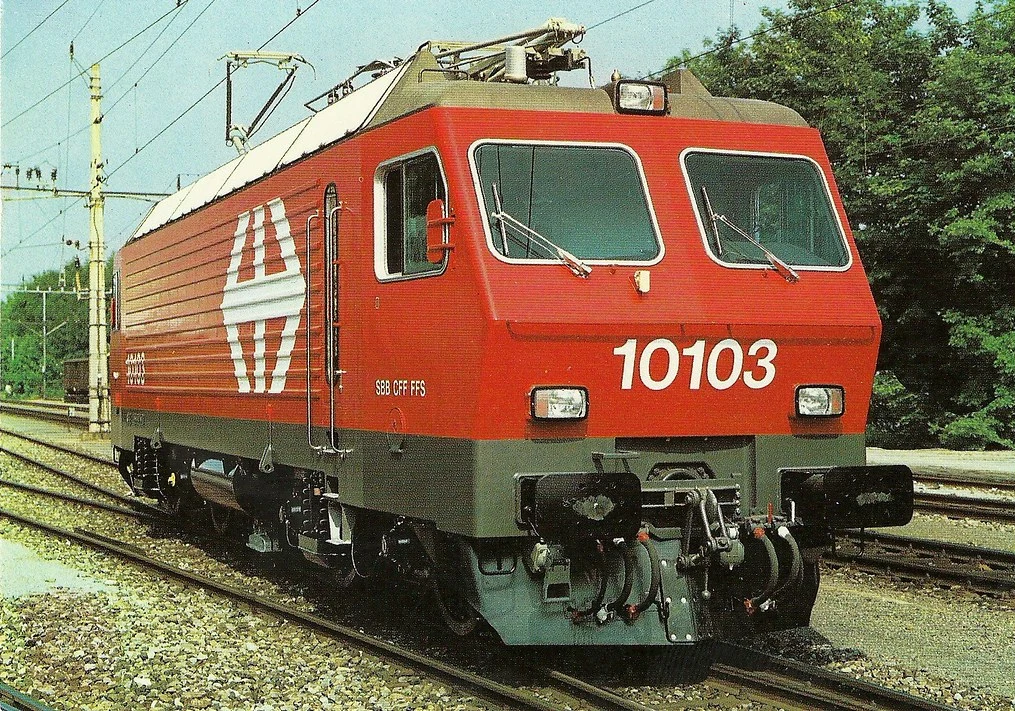
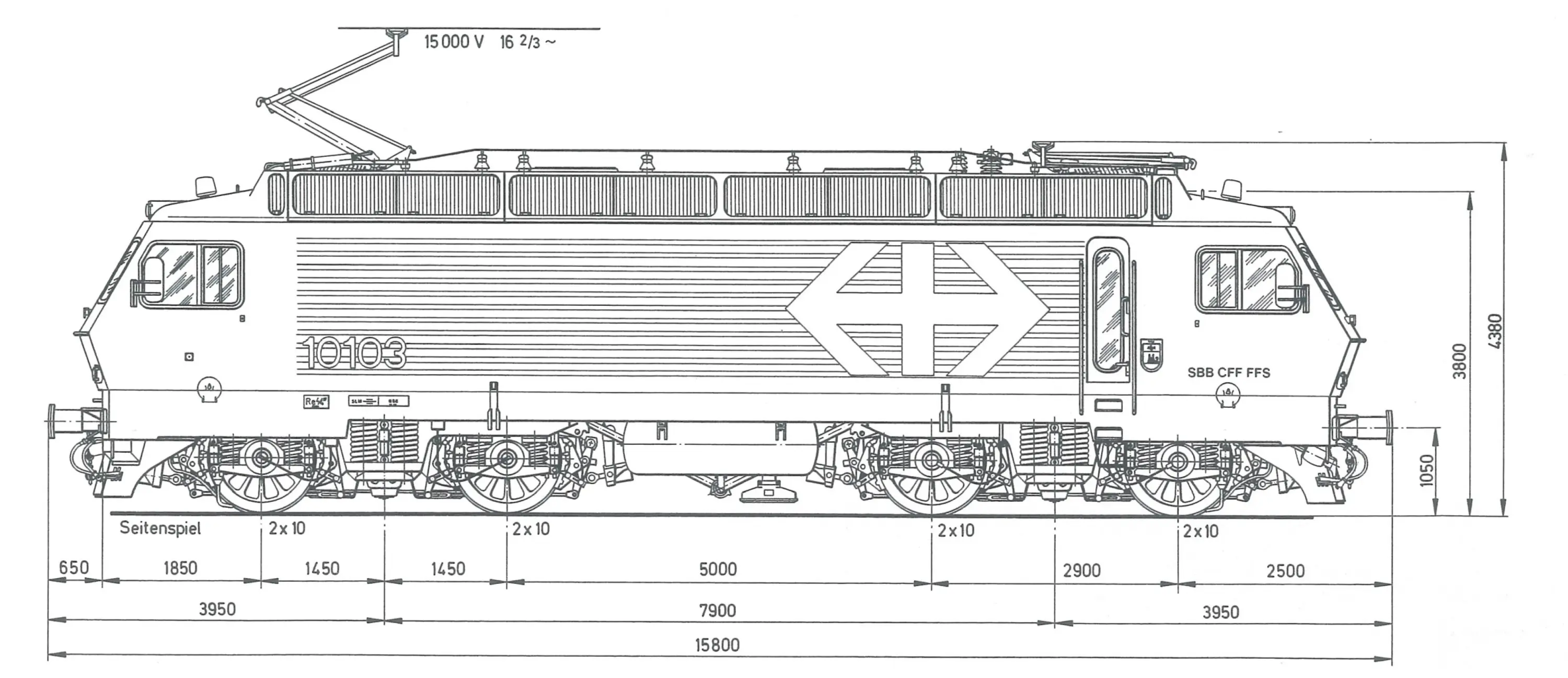
• 10103 – entirely red with an oversized SBB logo (this livery later inspired the design used on the Re 460 and HGe 4/4II);
• 10104 – completely red with a smaller SBB logo, similar to 10101 and 10102.
Each locomotive also received a distinctive coat of arms, following Swiss railway tradition:
• 10101 – Vallée de Joux (combined arms of Le Chenit, Le Lieu, and L’Abbaye);
• 10102 – Ostermundigen;
• 10103 – Luino (remarkably, the first SBB locomotive to carry a foreign city’s coat of arms);
• 10104 – Walenstadt.
The Re 4/4IV represented a major technological step forward for the SBB. The locomotives introduced thyristor-controlled AC traction systems, replacing the older resistor-based control of the Re 4/4II and Re 4/4III. Each unit developed a continuous output of about 5,050 kW at 85 km/h, allowing a maximum speed of 160 km/h — a new standard for Swiss locomotives at the time.
The design featured a light-steel body to reduce overall weight, keeping the axle load at 20 tonnes, essential for universal use on both flat and mountain lines. Two locomotives (nos. 10101 and 10102) were equipped with BBC gearboxes, while the other two (10103 and 10104) received SLM gearboxes, allowing comparative evaluation under identical service conditions.
They also incorporated electric dynamic braking (resistor type), though energy-recovery (regenerative) braking was not yet feasible with the early thyristor technology. Noise suppression systems proved complex and initially unreliable, sometimes interfering with track signaling and protection systems. The powerful cooling fans required for the thyristor electronics generated a distinctive and loud airflow noise, earning the locomotives the nickname “Staubsauger” (“Vacuum Cleaner”), while their boxy appearance led to the alternative moniker “Container”.
Early in 1983, locomotive 10104 reached 175 km/h during trials in the Heitersberg Tunnel, thus qualifying the class for its operational maximum of 160 km/h.
'80s - '90s
Although operationally successful and popular among both passengers and drivers for their smooth ride, the small class size made maintenance extremely costly. One locomotive was often cannibalized to keep the others running.
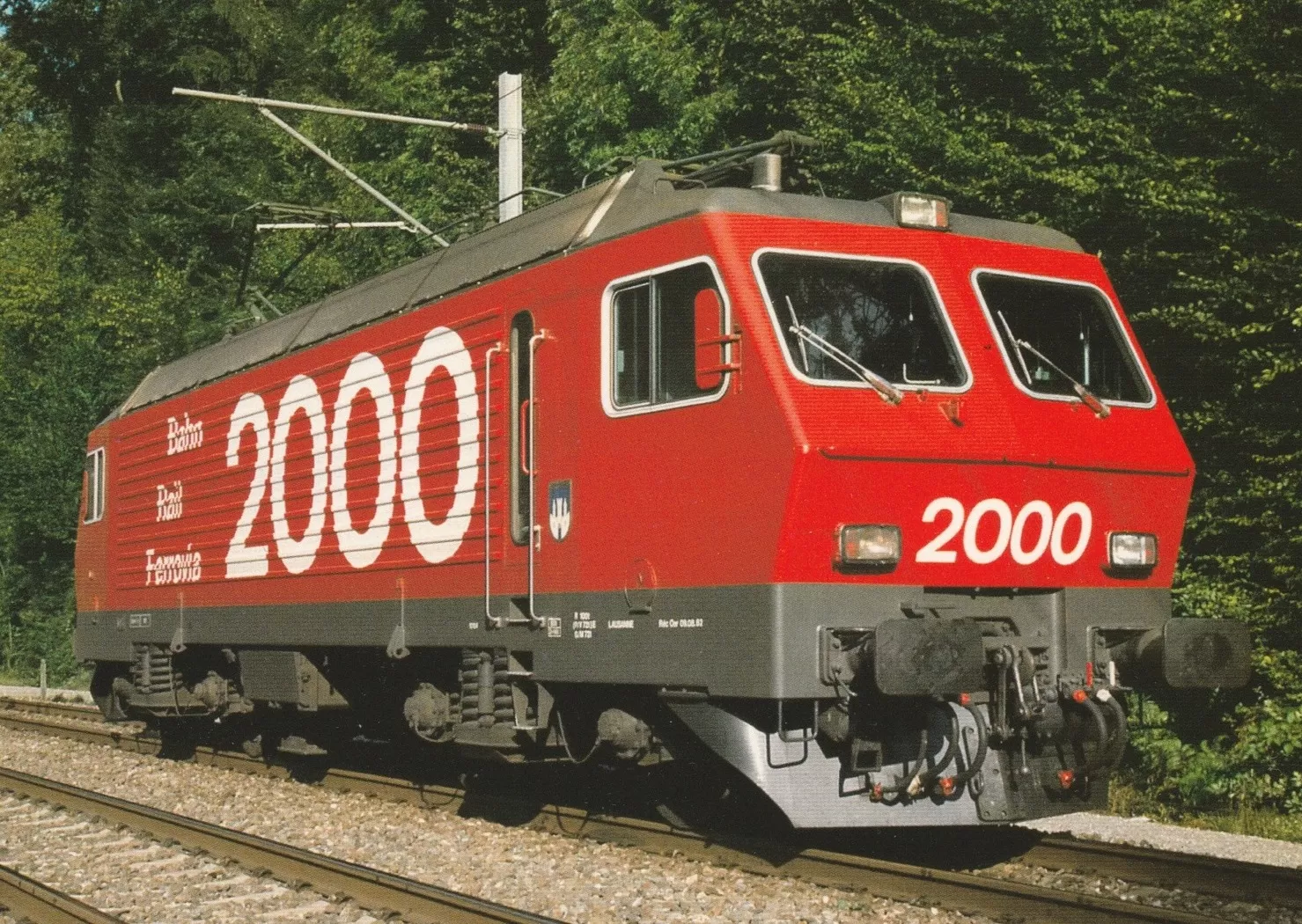
Between 1985 and 1986, all four prototypes received a uniform red livery carrying promotional markings for the Rail 2000 project. In 1992, this was replaced by a new corporate red scheme with a lined SBB logo, derived from the experimental design tested on 10103—the same design later adopted for the Re 460 series and HGe 101 locomotives on the Brünig line.
During their SBB career, the Re 4/4IVs were frequently seen along the Rhône valley, occasionally on the Zürich–St. Margrethen line, and at railway exhibitions promoting the slogan “In Zukunft die Bahn” (“The Railway of the Future”). In 1987, one locomotive achieved 188 km/h during speed trials, and a triple-heading test set a new Swiss speed record of 192 km/h, later surpassed only by the Re 460 in 1992.
Because of high maintenance costs and limited compatibility with existing fleets, the SBB decided not to produce a series batch. By the early 1990s, the Re 4/4IV had fulfilled its role as a technology demonstrator, paving the way for the Re 450 (for Zürich S-Bahn) and the Re 460, which became SBB’s new universal mainline locomotive.
Plans existed to renumber them as Re 440 000-003 under the 1992 UIC system, but this was abandoned when their transfer to another operator was negotiated.
1994
The remaining locomotives (10101 and 10104) followed in April 1995 and October 1996, having accumulated between 1.56 and 2.1 million km in SBB service.
Upon their arrival at the SOB, they were revised and renumbered as Re 446 015 - 018.
Do you have additional informations regarding this vehicle?
Help us writing the history of Re 4/4IV! Your knowledge is precious for us and the entire community, do not hesitate to share your facts, photos or videos:
Latest update on the 8th of November 2025 at 15:27
Contributor(s): Tudor C.
Advertising:
Re 4/4IV - Associated miniature models:

SBB CFF FFS - Re 4/4 IV electric locomotive
Recommended retail price: N/A
Advertising:

The identity card, photos and videos for thousands of railway vehicles all around Europe!
