


Source: Walter Ruetsch - bahnbilder.de

Source: bahnalltag.de


Source: flickr.com

Source: Peter Velthoen


Source: maurizio messa

Source: NAC


1949
1949 - 1950: From the Gotthard requirements to the SNCF CC 6051
The story of the Ae 6/6, however, begins not in Switzerland but with an experimental locomotive built for the French SNCF: the CC 6051.
Following the Second World War, Switzerland experienced strong economic growth and railway traffic increased accordingly. This was particularly noticeable on the Gotthard route, where increasingly heavy passenger and freight trains had to negotiate gradients of up to 26‰.
The existing SBB locomotive fleet included types such as the Ae 4/6, Ae 4/7 and the Ce 6/8II / Ce 6/8III "Crocodiles". Although these locomotives remained useful, heavy trains frequently required additional locomotives over the mountain section. Attaching and removing pilot or banking locomotives increased journey times, required additional personnel and reduced the overall efficiency of Gotthard operations.
The SBB therefore sought a powerful universal locomotive capable of working both express passenger and heavy freight trains. One of the principal requirements was the ability to haul approximately 600 tonnes over the 26‰ Gotthard gradients at 75 km/h. Low maintenance requirements, economical energy consumption and the reduction of costly pilot-locomotive operations were also important objectives.
At the end of 1949, the SBB commissioned Swiss industry to build two prototypes of this new generation of locomotive. The Swiss Locomotive and Machine Works (SLM) and Brown, Boveri & Compagnie (BBC) formed the original consortium, with Oerlikon Machine Factory (MFO) subsequently becoming involved in the project.
At almost exactly the same time, Swiss industry was developing another experimental Co’Co’ locomotive that would have a direct influence on the Ae 6/6.
The SNCF CC 6051 was built in Switzerland by SLM for the mechanical part and MFO for the electrical equipment. Delivered in 1950, it was one of several experimental locomotives intended for trials with industrial-frequency single-phase AC electrification on the Aix-les-Bains - La Roche-sur-Foron line in Savoy. The line initially used 20 kV 50 Hz, subsequently increased to 25 kV.
The CC 6051 was equipped with two three-axle bogies, giving it the Co’Co’ arrangement that would also be adopted for the Ae 6/6. Its mechanical design served as a basis for the development of the new SBB locomotive. The French locomotive was therefore an important direct precursor to the Ae 6/6, even though their electrical equipment was necessarily very different: the SBB network used 15 kV 16⅔ Hz AC, whereas the CC 6051 had been created for the French 50 Hz electrification experiments.
The CC 6051 was later renumbered CC 20001. Its successful operation also contributed to the development of the SNCF CC 25000 series, but for the SBB its importance lay above all in demonstrating the suitability of the two three-axle bogie arrangement that would form the mechanical basis of the Ae 6/6.
1952
1952 - 1954: Ae 6/6 prototypes 11401 and 11402
The locomotive was officially accepted by the SBB on 26 September 1952. The second prototype, Ae 6/6 11402, followed on 31 January 1953.
The two locomotives received the names:
Ae 6/6 11401: "Ticino";
Ae 6/6 11402: "Uri".
Their names were highly symbolic. Ticino and Uri lie respectively on the southern and northern sides of the Gotthard and were therefore intimately associated with the railway for which the new locomotives had primarily been developed.
The Ae 6/6 used two three-axle bogies with all six axles powered. Its hourly output of approximately 6'000 hp allowed it to haul around 650 tonnes at 75 km/h on the Gotthard ramps, while trains of approximately 1'600 tonnes could be handled on the flatter sections.
Extensive trials were conducted with the two prototypes, particularly on the Gotthard. Although their basic performance fulfilled the SBB’s requirements, testing also revealed important weaknesses.
The original bogies had relatively rigidly guided wheelsets, resulting in considerable forces when negotiating curves and consequently high wear on both wheel flanges and rails. This was particularly problematic on a mountain railway with numerous curves such as the Gotthard.
The experience gained from 11401 and 11402 led to several modifications before series production. These included changes to the wheelsets and wheel flanges intended to improve curve negotiation and reduce wear.
The trials nevertheless demonstrated that the fundamental concept was successful. In 1954, the SBB ordered the first twelve production locomotives, numbered Ae 6/6 11403 - 11414.
1955
1955 - late 1960s: Series production and the rise of the Gotthard locomotive
A total of 118 production locomotives, Ae 6/6 11403 - 11520, followed the two prototypes. When the final locomotive entered service in 1966, the complete Ae 6/6 fleet comprised 120 locomotives. Each production locomotive represented an investment of approximately CHF 1'625'000.
Experience with the locomotives being delivered continuously resulted in further detail improvements throughout production. The basic concept, however, remained unchanged and developed into an extremely successful universal locomotive suitable for both passenger and freight traffic.
The Ae 6/6 also introduced one of the most recognisable visual traditions of the post-war SBB. The first 25 locomotives, 11401 - 11425, were associated with the Swiss cantons and became known as the “Kantonslokomotiven” or canton locomotives. They carried cantonal coats of arms on their sides and were distinguished by elaborate polished chrome-steel decorative strips. Together with the green body, Swiss crosses on the fronts and large coats of arms, these decorations gave the Ae 6/6 an appearance considerably more prestigious than that of a conventional utility locomotive. The naming and presentation of the locomotives generated considerable public interest and helped transform the Ae 6/6 into a symbol of the SBB and the Gotthard railway.
Beginning with 11426, the expensive chrome side decorations were omitted. Locomotives 11426 - 11520 instead received the coats of arms and names of Swiss towns and municipalities and consequently became known as “Städtelokomotiven”, or city locomotives. There was later one important exception to the original division between canton and city locomotives. Following the creation of the Canton of Jura, one of the city locomotives was renamed in 1979 so that the new canton could also be represented by an Ae 6/6.
During the second half of the 1950s and throughout the 1960s, the Ae 6/6 became the Gotthard locomotive par excellence. The class was genuinely universal. Ae 6/6 locomotives could be found at the head of important passenger trains as well as heavy freight trains, making much better use of a single locomotive than had been possible with previous generations. Their approximately 4'300 kW output and six powered axles were particularly valuable on the 26‰ Gotthard ramps. The ability to haul around 600–650 tonnes uphill at approximately 75 km/h allowed many trains to run without the additional locomotive previously required.
The class was not confined exclusively to the Gotthard. Ae 6/6 locomotives also appeared on the Simplon route, while their operating range gradually expanded elsewhere on the SBB network. From around 1960, diagrams extended as far as Bern and Basel. Some locomotives were also allocated to western Switzerland. The later machines 11451 - 11520 were initially assigned to Bellinzona, while thirteen locomotives were transferred from there to Lausanne between 1964 and 1969.
The two prototypes had a somewhat different career. Because of their technical differences and higher maintenance requirements, 11401 and 11402 were withdrawn from regular Gotthard duties earlier than the production locomotives, during the late 1960s.
1970
1970s - 1980s: Re 6/6 and the move away from the Gotthard
Freight trains were becoming heavier, passenger services faster, and the absence of multiple-unit control became an increasingly important disadvantage. Operating two Ae 6/6 locomotives together required more personnel than locomotives equipped for multiple-unit working.
The three-axle bogies were another disadvantage. Although they provided excellent adhesion, their long rigid wheelbase generated greater lateral forces and rail wear than the two-axle bogies used by more modern locomotives.
From the middle of the 1970s, the Ae 6/6 increasingly faced competition from newer locomotives, particularly the Re 6/6 and Re 4/4II. These locomotives offered more modern running gear and multiple-unit operation, while the Re 6/6 provided considerably greater performance for heavy Gotthard trains. As Re 6/6 locomotives entered service, the Ae 6/6 progressively lost its dominant position on the Gotthard.
Many were transferred to the Swiss Plateau and other parts of the SBB network, where their power remained valuable. They continued to work a wide variety of trains, but freight traffic gradually became increasingly important in their duties. The two prototypes followed this geographical shift as well. In the summer of 1980, 11401 and 11402 were transferred from Erstfeld to Zürich.
1984
From green to red
A major visual change began after the SBB introduced red as the standard colour for its electric bogie locomotives in 1984. Ae 6/6 locomotives subsequently passing through overhaul were gradually repainted red, although the process extended over many years and some locomotives retained green liveries much longer than others. As a result, red and green Ae 6/6 locomotives became a familiar sight operating alongside one another during the later decades of the class’s SBB career.
1990
1990 - 1998: From universal locomotive to freight locomotive
The prototypes were particularly expensive to maintain because of their differences from the production series. In 1997, there were plans to withdraw 11401 and 11402 from regular service and use them for depot duties and as stationary compressed-air suppliers at Rorschach. A shortage of locomotives, however, soon returned them to regular operation.
Despite their age, the Ae 6/6 remained useful and reliable machines. Almost half a century after the first prototype had appeared, the class was therefore still an active part of the SBB locomotive fleet.
1999
Transfer to SBB Cargo
Do you have additional informations regarding this vehicle?
Help us writing the history of Ae 6/6 11401 - 11402! Your knowledge is precious for us and the entire community, do not hesitate to share your facts, photos or videos:
Latest update on the 16th of September 2026 at 22:30
Contributor(s): Tudor C.
Advertising:
Ae 6/6 11401 - 11402 - Related videos:

Ae 6/6 11401 - 11402 - Associated miniature models:

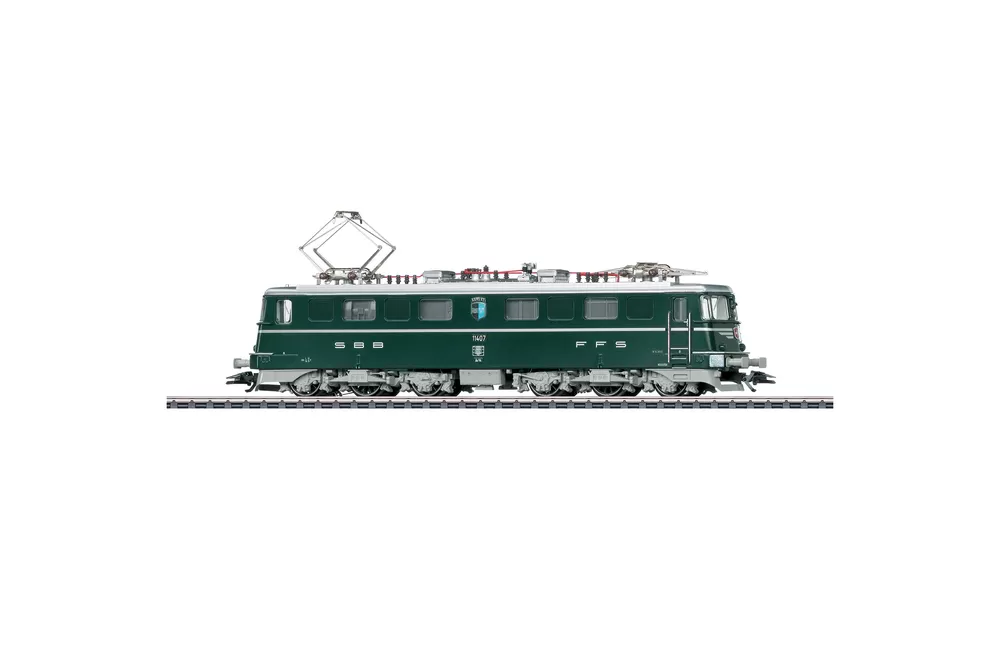
SBB CFF FFS - Ae 6/6 electric locomotive
Recommended retail price: from 459,90 €

SBB CFF FFS - Ae 6/6 electric locomotive
Recommended retail price: from 379,00 €

SBB CFF FFS - Ae 6/6 electric locomotive
Recommended retail price: from 379,00 €

SBB CFF FFS - Ae 6/6 11401 TICINO electric locomotive
Recommended retail price: from 459,90 €
Advertising:

The identity card, photos and videos for thousands of railway vehicles all around Europe!
