
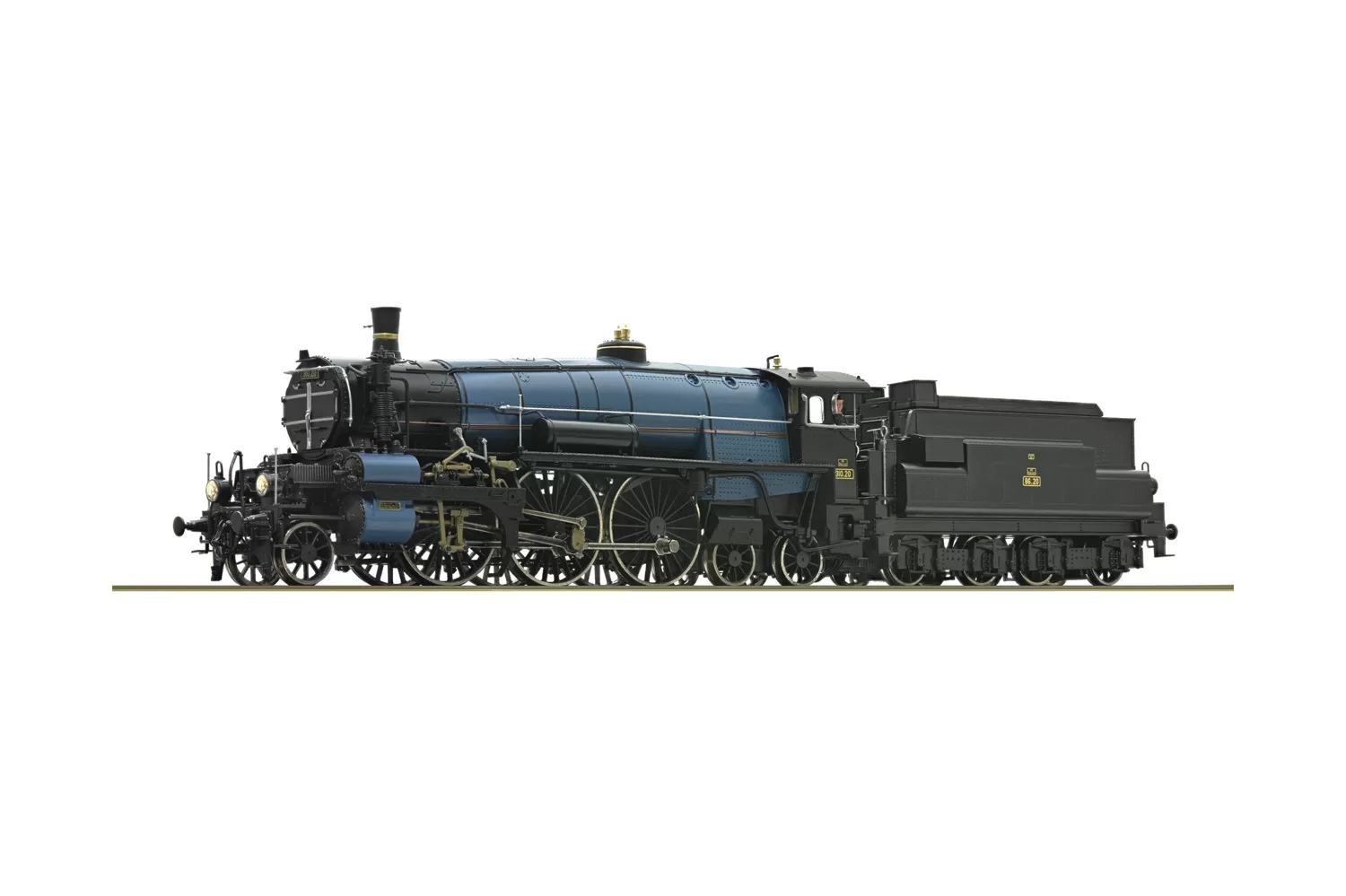
ÖBB - Class 310 steam locomotive

Scale:
Markings:
Add
About the model
Steam locomotive 310.20 of the Austrian Federal Railways.
Edition model!
Drive on two axles of the tender and via cardan shaft on all three locomotive driving axles.
■ Finely-detailed chassis
■ Filigree reproduction of the control
■ NEM finescale metal spoked wheels
■ Opening smokebox doors
■ Many separately attached details
■ Retrofittable smoke generator
Due to increased train weights in express train traffic, the most influential designer for Austrian steam locomotive construction, Ing. Dr. h.c. Karl Gölsdorf, developed a new express locomotive with the wheel arrangement 1'C2' in 1906. This, compared to the Pacific type popular in many countries, was an "inverted" axle arrangement, which made it possible to accommodate a large upright boiler with a wide grate. Together with the weighty four-cylinder compound engine, it was possible to create a high-performance locomotive despite the low Austrian axle load limit of only 14.5 t. This locomotive is considered by many railway enthusiasts to be the most beautiful steam locomotive in Austria.
Whereas the first 11 engines were delivered in wet steam design, the other 90 examples of this type were put into service as series 310 superheated steam locomotives and used by the kkStB mainly on the Nordbahn, the Franz-Josefsbahn and the Westbahn between Vienna and Salzburg as a high-quality passenger train service.
The "Russian Iron" was an alternative to primed and painted sheet metal in the early railway eras, but also represented an aesthetic element. It was only used around locomotive areas with high heat radiation, such as the panelling on the boiler and cylinder.
The black and white photos at our disposal suggest that locomotives of the 310 series also received "Russian Iron" panelling. Images in colour also support this assumption. In terms of colour design, the black-painted smoke chamber panelling provides striking accents. This contributes to the highly attractive appearance of this unusual locomotive design.
...
Edition model!
Drive on two axles of the tender and via cardan shaft on all three locomotive driving axles.
■ Finely-detailed chassis
■ Filigree reproduction of the control
■ NEM finescale metal spoked wheels
■ Opening smokebox doors
■ Many separately attached details
■ Retrofittable smoke generator
Due to increased train weights in express train traffic, the most influential designer for Austrian steam locomotive construction, Ing. Dr. h.c. Karl Gölsdorf, developed a new express locomotive with the wheel arrangement 1'C2' in 1906. This, compared to the Pacific type popular in many countries, was an "inverted" axle arrangement, which made it possible to accommodate a large upright boiler with a wide grate. Together with the weighty four-cylinder compound engine, it was possible to create a high-performance locomotive despite the low Austrian axle load limit of only 14.5 t. This locomotive is considered by many railway enthusiasts to be the most beautiful steam locomotive in Austria.
Whereas the first 11 engines were delivered in wet steam design, the other 90 examples of this type were put into service as series 310 superheated steam locomotives and used by the kkStB mainly on the Nordbahn, the Franz-Josefsbahn and the Westbahn between Vienna and Salzburg as a high-quality passenger train service.
The "Russian Iron" was an alternative to primed and painted sheet metal in the early railway eras, but also represented an aesthetic element. It was only used around locomotive areas with high heat radiation, such as the panelling on the boiler and cylinder.
The black and white photos at our disposal suggest that locomotives of the 310 series also received "Russian Iron" panelling. Images in colour also support this assumption. In terms of colour design, the black-painted smoke chamber panelling provides striking accents. This contributes to the highly attractive appearance of this unusual locomotive design.
Catalogs / brochures

Available article numbers:
Roco 70330
Technical specifications:

2-rail (direct current - DC)

Flywheel drive

NEM 652 8-pole interface

Number of axles with traction tyres
2

Number of driven axles
5

Coupler standard pocket (NEM 362)

Coupler with close coupling cinematic

Double headlights alternating with the direction of travel

Length over buffers
248 mm

Minimum drivable radius
358 mm
Show more
Roco 70331
Technical specifications:
2-rail (direct current - DC)

DCC (Digital)
Flywheel drive
NEM 652 8-pole interface

Integrated sound
Number of axles with traction tyres
2
Number of driven axles
5
Coupler standard pocket (NEM 362)
Coupler with close coupling cinematic
Double headlights alternating with the direction of travel
Length over buffers
248 mm
Minimum drivable radius
358 mm
Show more
Roco 78331
Technical specifications:

3-rail (alternating current - AC)
DCC (Digital)
Flywheel drive
NEM 652 8-pole interface
Integrated sound
Number of axles with traction tyres
2
Number of driven axles
5
Coupler standard pocket (NEM 362)
Coupler with close coupling cinematic
Double headlights alternating with the direction of travel
Length over buffers
248 mm
Minimum drivable radius
358 mm
Show more
Advertising:

The identity card, photos and videos for thousands of railway vehicles all around Europe!
Copyright © 2026 T&H Services - All rights reserved
Powered by
